Categories
Awareness raising Diversity and Inclusion Government of Canada Public service White women

How my white women bosses terrorized me

The global response to George Floyd’s death has got people talking about other incidents where white people did bad things to Black people. One of those incidents surfaced in a viral video of a white woman threatening to call the police, then doing so, on a bird-watching African-American man who asked her to leash her dog in New York’s Central Park. Amy Cooper’s apology to Christian Cooper (no relation), following her being fired, is a classic case of too little waaaay to late.

In his New York Times article, How White Women Use Themselves as Instruments of Terror, Charles M. Blow argues that what Cooper did was simply the latest in a long history of white women using themselves as weapons against Black men. And Blow adds, “There are too many noosed necks, charred bodies and drowned souls for them to deny knowing precisely what they are doing.” I agree and here’s why…

In the fall of 2017, I got a new boss. She was my sixth boss in 18 months and she immediately began micromanaging me on a level that, to me, qualified as my first case of professional harassment. I told my union representative about it and he told me he had informed the Director General. I heard nothing from the DG for about a month while the situation with my boss worsened. Then, one day, after a tense email exchange with my boss, I went to a meeting in a boardroom full of my colleagues, who were mostly white women. When I entered the meeting, I saw my boss sitting at the table, went to her and asked, “Was my email clear?”. I was angry and tense when I said it. In response, she sent an email to my DG that said, “He is getting in my face in a threatening way.” (I got the email through Access to Information – i.e. the federal government equivalent of taking part in a slave rebellion.) A few minutes later, my DG entered the room, came over to where I was sitting silently in the corner and said, in front of all my colleagues, “ Robin. Do you have an issue? Because we can’t have you threatening your colleagues.” (This is the same person who, as I explained in Tales from the Plantation #1, had me banned from all of my workplace buildings without informing me.)

Despite the many complaints I have filed since that day, neither my former boss nor the DG have been held accountable, in fact, the DG got promoted. The global reaction to George Floyd’s death provides some perspective on why that is.

Systemic discrimination means it’s normalized. Black folks suffer it every day. It’s not unusual. It’s not spectacular – and it’s rarely, if ever, filmed. However, like the cops who killed Floyd, the people abusing Black folks in the federal public service know exactly what they’re doing.

Blow’s argument that white women know what they’re doing is counter to the idea of “unconscious bias” that is so popular in government discussions of systemic discrimination. The idea is that, since the bias is unconscious, all we have to do is make it conscious for people through awareness training and all will be well.

However, my experience shows that isn’t the case. All that great awareness I’ve raised by taking the risk to speak out and file complaints has only made my harassers more aware that what they’re doing is wrong – but hasn’t stopped them from doing it. It has also resulted in me being hit by one sanction after another for the last two years.

That’s because systemic discrimination privileges certain groups over others and those on top don’t want to share the goodies. We must recognize that folks act in their own interest so, to get them to do the right thing in terms of diversity and inclusion, we have to change the system so that there are much bigger rewards for doing the right thing – and much bigger penalties for doing the wrong thing.

They should start by setting targets for executives, like actually hitting their legally mandated Employment Equity Act numbers by hiring, and promoting, all the talented Black folks around, and withholding their performance bonuses if they don’t.

Black lives matter – but docking performance pay gets results.

Categories
Coops COVID19 Sharing economy

COVID19 should be Black folks’ Ujam-Ahh! moment

The COVID19 pandemic reveals the potential of cooperatives as vehicles for economic development in Black communities.

In the “sharing economy”, exemplified by companies like Uber and Airbnb, just about anything can be shared – except the profits. The profits go the owners/shareholders as they did long before run-of-the-mill capitalism was upset by “disruptive” capitalism.

However, in the U.S., the COVID19 pandemic has shown that traditional capitalist companies, where a few owners, or many faceless shareholders, share the profits, risks and decisions, have not fared as well as those based on a very different model: cooperatives.

In his May 8 Truthout article, Pandemic Crash Shows Worker Co-ops Are More Resilient Than Traditional Business, Tessa Collective member Brian Van Slyke, gives examples of how, and reasons why, some American coops are weathering COVID better than their traditional counterparts.

Slyke quotes Esteban Kelly, executive director of the U.S. Federation of Worker Cooperatives, of which the TESA Collective is a member:

“Traditional firms, when times are good, they take that surplus, they distribute it to the investors or maybe pay off debt, but they don’t necessarily do a lot of bonus pay for rank-and-file or increase wages…When times are bad, they panic…They’re slashing jobs and benefits…” Kelly says things are different with coops. “When worker-owned businesses are doing well, they share the benefits among worker-owners. This is most commonly achieved by increasing wages, expanding benefits, distributing dividends to the employees (instead of absentee stockowners) and reinvesting in their communities. But when business is tough, a worker cooperative equitably shares the burden. Instead of mass layoffs, the workers, who are the equal owners, strive to find collective solutions. Worker-owners might vote to take voluntary pay cuts so no one person loses their job, and worker committees might try to find new markets the cooperative can expand into.” Slyke gives several examples of U.S. coops doing just this in response to the pandemic.

Cooperatives aren’t a new idea, including among African-Americans.

Long before Dr. Maulana Karenga created Kwanzaa in 1966 with its fourth principle of cooperative economics, Ujamaa, Ella Baker and George Schuyler launched the Young Negroes Cooperative League (YNCL) in Pittsburgh in 1930. (Baker would go on to form the Student Non-violent Coordinating Committee with Martin Luther King). As Barbara Ransby explains in her book, Ella Baker and the Black Freedom Movement – A Radical Democratic Vision, the idea was to form “black consumer cooperatives as a strategy to combat the economic devastation being wreaked by the depression and to educate black people about socialism.” This, at a time when Blacks in the southern US were still struggling under the crushing poverty of one of the many systems that replaced slavery: sharecropping.

According to the PBS article, Slavery by Another Name:

“After the Civil War, former slaves sought jobs, and planters sought laborers. The absence of cash or an independent credit system led to the creation of sharecropping. Sharecropping is a system where the landlord/planter allows a tenant to use the land in exchange for a share of the crop. This encouraged tenants to work to produce the biggest harvest that they could, and ensured they would remain tied to the land and unlikely to leave for other opportunities. In the South, after the Civil War, many black families rented land from white owners and raised cash crops such as cotton, tobacco, and rice. In many cases, the landlords or nearby merchants would lease equipment to the renters, and offer seed, fertilizer, food, and other items on credit until the harvest season…High interest rates, unpredictable harvests, and unscrupulous landlords and merchants often kept tenant farm families severely indebted. Laws favoring landowners made it difficult or even illegal for sharecroppers to sell their crops to others besides their landlord, or prevented sharecroppers from moving if they were indebted to their landlord. Approximately two-thirds of all sharecroppers were white, and one third were black.”

Although sharecropping hadn’t done great things for Black folks, sharing had. Ransby explains that, “Cooperation, the sharing of resources, and a strong community spirit were fundamental values among African Americans. Ella Baker’s extended family was part of a larger network of black farmers in Warren County, North Carolina, who emphasized self-help and mutual aid as strategies for survival and the betterment of the race. The cooperative ethos that permeated Baker’s childhood was deeply implicated in prevailing notions of family and community; groups of individuals banding together around shared interests and promoting a sense of reciprocal obligation, not of individualism and competition. For example, African American farmers exchanged goods, services, and other resources among themselves. Expensive farm equipment was purchased collectively or used communally.”

Despite its promise, the YNLC only lasted about five years and “eventually collapsed under the weight of financial obligations” according to Ransby. She says Schuyler’s biographer, Michael Peplow, also attributed the YNCL’s failure partially to the fact that, “Schuyler’s inflammatory remarks about the black church and the black middle class had made him too many enemies.” For example, Schuyler had emphasized that, “…young [YNCL] recruits had to be militants, pioneers, unswerved by the defeatist propaganda of the oldsters, and the religious hokum of our generally parasitic clergy.”

So are there any signs of a cooperative resurgence among Black folks today? Yep.

After years of teaching and serving as a principal in Detroit schools, helping lead the Detroit Black Community Food Security Network (DBCFSN) and starting D Town Farm on the city’s west side, Malik Yakini and DBCFSN are planning a 34,000-square-foot food co-op, event space, and commercial kitchens in Detroit’s North End neighborhood. The Detroit People’s Food Coop could serve as a proof-of-concept for the ability of co-ops to build wealth, create food security, and drive investment in underserved communities.

(June 12 addition): Events in the US following the death of George Floyd have many people comparing Canada with the US and saying we’re glad “we’re not like them”. Modeling initiatives like the Detroit People’s Food Coop would be a good place to make an exception to that.

Categories
CHRC FBEC Proof

Tales from the Plantation #4

Burden of proof should be on those accused of discrimination not their accusers

Currently, people who file union grievances against their managers or make complaints of discrimination to organizations like the Canadian Human Rights Commission, alleging discrimination based on race, must prove two things: that discrimination happened and that it was based on race. This is almost impossible to do as most organizations require proof similar to that of the Human Rights Legal Support Centre (HRLSC). The HRLSC is an independent agency, funded by the Government of Ontario, to provide legal services to individuals who have experienced discrimination. Its website states:

“To prove discrimination, you must show that there is a connection…between negative treatment that you experienced and one of the personal characteristics (or prohibited grounds of discrimination) listed in the the [Human Rights] Code.

Put another way, to prove discrimination, you need to show…that you were subjected to negative treatment because of your gender, place of origin, family status or any one of the Code-protected personal characteristics.”

Meeting these requirements is next to impossible because, by definition, discrimination means someone doing something to you that they’re not doing to others. How do you prove they’re not doing it to others and that the difference is based on race?

One obvious way to get an answer to the first question in the workplace would be to ask your colleagues if they’re treated the same way. That works for very visible things like telework. For things like that, you don’t even have to ask as, if your manager denies your telework request, it’s pretty easy to see if she approved others’ requests because they’re not around. However, less visible types of discrimination are harder to deal with.

I had such an example recently where my boss called a meeting to engage in what I label “hyper critique”. Hyper critique is when a manager rarely, if ever, praises an employee’s work, but critiques it, most often in private meetings. Hyper critique is a common complaint of our Federal Black Employee Caucus members.

Proving whether my boss hyper critiques my colleagues is challenging. I could ask them, but most people are, understandably, reluctant to admit if they are subject to such things. They’re also often reluctant to admit if they’re not subject to such things as they may see that as admission that they’re getting preferential treatment.

So what can you do? Right now, not much. That’s why I recommend we push the public service to do three things:

  1. Shift the burden of proof to those accused of discrimination instead of their accusers; require the accused to prove that they’re not discriminating.
  2. Until the burden of proof is shifted from accuser to the accused, create a discrimination investigator function staffed with someone given the power to investigate claims of discrimination, including being able to mandate colleagues to reveal, in anonymous interviews, if they have been subject to the same treatment.
  3. Start collecting race-based data on who managers sanction.

People who are being harassed and discriminated against have enough to deal with. Let’s take one thing off their plate.

Note: The opinions expressed here are my own and do not necessarily reflect those of the Federal Black Employee Caucus. To contact an FBEC spokesperson use the Contact Us page on FBEC’s website.

Categories
GDPR GoC Regulation SurCap

All the great “free” stuff we get from Google and Facebook is costing us a lot more than our privacy

In my post, COVID-19 could mean we lose and surveillance capitalists win — again, I discussed some of the challenges of surveillance capitalism (surcap). This post starts the discussion of what we can collectively do about those challenges.

One of the first issues is who is “we”? Only those who think there’s a problem will see the need for a solution. However, unlike the rise of the resistance to industrial capitalism that was partly fuelled by people slaving under horrible working conditions, surveillance capitalism’s most negative effects are mostly cloaked. Most people see only the benefits like free search, email and YouTube.  

For those that do see a problem, there are, thus, two challenges:

  1. How to fight back.
  2. How to get more people to join the fight.

As knowing how to fight back is key to getting more people to join the fight, let’s focus on that for now.

The success of surveillance capitalism is due to a lot more than lots of folks feeling hooked on great, free tools like Facebook and Gmail. In her book, The Age of Surveillance Capitalism, released in February 2019, Shoshana Zuboff identifies 16 reasons for surcap’s success. Here are 7 of them, including the most personal ones:

  1. Unprecedented – Surcap is a completely new phenomenon so we have a hard time fully understanding it as we tend to compare it to things we know.
  2. Velocity – “Surcap rose from invention to domination in record time”, says Zuboff. She says this is by design to freeze resistance while distracting us with immediate gratification.
  3. Inevitability – Surcap rhetoric makes us believe that it’s all inevitable and we should simply accept it, enjoy its benefits – and don’t think too much about any possible down side.
  4. Inclusion – Paraphrasing Zuboff, “Many people feel that if you’re not on Facebook, you don’t exist. People all over the world raced to participate in Pokemon Go. With so much energy, success and money flowing into surcap, standing outside of it, let alone against it, can feel like a lonely and risky prospect.”
  5. Ignorance – Surcap’s inner workings are secretive by design. Their systems are intended to ensnare us, preying on our vulnerabilities bred by an unequal balance of knowledge, and amplified by our scarcity of time, resources and support.
  6. Dependency – Most people find it difficult to withdraw from using surcap’s free tools and many wonder if it is even possible.
  7. No alternatives – There just aren’t great alternatives to Google Search, in terms of quality, and Facebook in terms of ubiquity. There are better alternatives to things like Gmail and Google Docs but, with so many people using them, it’s very hard to switch.

However we decide to combat surcap, one thing is clear: we can’t do it on our own. Stopping surcap’s march will require many of us constantly pushing our governments to bring in effective regulation – and working to get more folks to join the fight. 

In terms of government regulations, Zuboff says many hopes today are pinned on the EU’s new General Data Protection Regulation (GDPR), which became enforceable in May 2018. The EU approach fundamentally differs from that of the US in that companies must justify their data activities within the GDPR’s regulatory framework. The regulations introduce several key new substantive and procedural features, including:

  • a requirement to notify people when personal data is breached;
  • a high threshold for the definition of “consent” that puts limits on a company’s reliance on this tactic to approve personal data use;
  • a prohibition on making personal information public by default;
  • a requirement to use privacy by design when building systems;
  • a right to erasure of data; and
  • expanded protections against decision making authored by automated systems that imposes “consequential” effects on a person’s life.

The new regulatory framework also imposes substantial fines for violations, which will rise to a possible 4% of a company’s global revenue, and it allows for class-action lawsuits in which users can combine to assert their rights to privacy and data protection. 

In May, 2019, Jim Balsillie, co-founder of Research in Motion that created the Blackberry, made other suggestions for what governments can do. Balsillie appeared as a witness, alongside Zuboff and Zucked author Roger McNamee, at a hearing of the International Grand Committee on Big Data, Privacy and Democracy, in Ottawa and suggested:

  1. Eliminating tax deductions of specific categories of online ads.
  2. Banning personalized online advertising during elections.
  3. Implementing strict data governance regulations for political parties.
  4. Providing effective whistle-blower protections.
  5. Adding explicit personal liability alongside corporate responsibility to affect CEO and board of director decision-making.
  6. Creating a new institution for like-minded nations to address digital co-operation and stability.

The Grand Committee is a first step towards achieving #6 as it has members from around the globe, some of whom come from countries like the Philippines which are already experiencing life and death consequences of uncontrolled surcap. However, it is #5 that may have the most impact given one of the most dangerous impacts of surcap: an increase in online hate fuelled by real “fake news”.

One of the points that came through clearly at the Committee hearing is the most disturbing: surcap companies resist removing hateful content and fake news because it generates by far the most engagement and the most money. Balsillie’s point was that making CEOs and board members personally liable for such content would make them think twice about letting it proliferate on their platforms.

So now it’s up to us to demand that our political leaders start implementing ideas like Balsilli’s.

Our very freedom is at stake just like it was during the Second World War. Only this time, instead of being controlled through blatant terror by a power that knows very little about us, we’re being controlled through hidden systems by powers that know almost everything about us.

Categories
COVID19 SurCap

COVID-19 could mean we lose and surveillance capitalists win — again

This post is on rabble.ca

Update, April 18 – Since posting this, I found some good blog posts on The Age of Surveillance Capitalism. Barbara Fisher’s post, The Age of Surveillance Capitalism: A Mixed Review on the Inside Higher Ed site, nicely explains how businesses aren’t just using the predictions about our behaviour that they buy from surveillance capitalists to help them better target their ads:

“That Fitbit your employer paid for? It feeds information to insurers that can use to change your behaviour and reduce costs – or charge you more if you don’t comply. Google drove into our neighbourhoods with camera-equipped cars to capture images of our communities and create detailed maps that will be useful for routing their self-driving cars and even planning entire cities where everything will be connected and everyone’s life experience moment by moment can be rendered as data.”

Categories
Education OCDSB Trustees

Covid19 brings out the best in all of us (ok, only some of us)

Although the covid19 pandemic has generated lots of great stories of people coming together to help one another it has also led to the kind of stories that don’t surprise Black folks one bit: covid-related confrontations with white people.

On Friday March 27, a young Black man here in Ottawa was the victim of such a confrontation with a white woman who apparently was a self-appointed covid19 rule enforcer.

After being cooped up for weeks, the young man had sought out, and found, an empty basketball court to shoot some hoops. While there, he was confronted by a woman who accused him of breaking covid19 social distancing protocols and proceeded to interrogate and verbally threaten him. She then posted her version of events on Facebook, including this comment:

“So I had to go to the drugstore for an essential and then bought deodorant. I am sure my pets love me no matter what I smell like. When I got home people playing basketball in the park. Went over to politely ask them to leave, kid gave me attitude and played dumb. Then I said, parlez-voux francais? Yeh kid I can argue in both official languages.” (sic)

In her post, she also revealed what elementary school the boy, now in high school, had attended.

According to the boy’s father, and clearly evident from the picture taken by the woman herself, his son was in fact at the park by himself as he had specifically looked for a hoop with no one around.

(I include the photo only because it was already published online as, unlike the woman apparently, I want to respect the boy’s privacy and I care about his safety). The boy also told his father that the woman said, “Oh you’re graduating? If you are, I will be at the graduation ceremony and I will trip you before you get your diploma.” and “You’re going to go to Innes road”, clearly making the racist insinuation that, because he is Black, the young man is destined to end up in Ottawa’s notorious detention centre.

The woman’s actions were appalling, especially given who she is: Donna Blackburn, the Ottawa Carleton District School Board trustee for the very school the boy attends.

Blackburn’s actions violate school board policy on a number of fronts.

The Board’s Code of Conduct states that, “It is a policy of the Board that a positive school climate exists when all members of the school community feel safe, comfortable, accepted and valued.” Blackburn’s actions will clearly make the young man feel the exact opposite. 

The Code’s standards of behaviour fall into two categories: things that people should do and things they should not do. It states that all members of the school community should, “act with decorum and be respectful of other Board members, staff, students and the public.” The Code says that school community members should not engage in bullying behaviours and what Blackburn did was clearly bullying.

Blackburn’s actions also violate the Board’s privacy policy which states that members of the school community should, “…practice good digital citizenship by being respectful when they post photos of others, which includes only posting photos involving…students with permission.”

This is not the first time that Blackburn has run afoul of Board policy. In December 2016, she was under fire for accusing her Board colleague, Erica Braunovan, of “buying her children” after Braunovan adopted two young daughters from Guyana. Then, a year later, in December 2017, Braunovan filed another complaint against Blackburn for emails Blackburn sent her that, once again, violated the Board’s Code.

The Black community quickly mobilized to demand Blackburn’s resignation and that effort continues. However, the larger question is why Blackburn has been allowed to remain and do so much damage for so long? It’s true that, as she’s an elected school trustee, she can’t be “fired”, but there are clearly other ways to get problem trustees to “see the light” and do the right thing. This seems to have been accomplished with York region school trustee, Nancy Elgie, following public outrage at her racist comments.

Both cases also raise questions about why these people were elected in the first place. Did they only put on their metaphorical white hoods after the election – or did voters elect them with their hoods proudly on?

Food for thought…

Categories
#TFTP #wetoo 613-819 Black Hub FBEC Government of Canada Plantation tales

Tales from the Plantation #2

When I left off my story in Tales from the Plantation #1, the formal work action plan, and the manager who had imposed it on me, were both gone and I was back working in the buildings from which I had been banned, as if nothing had happened.

I worked like this for months, feeling a bit like Keanu Reeves’ character Mr. Anderson from The Matrix. All my colleagues seemed unaware that we worked in a place that bans people from buildings for asking questions.

In the summer, I asked for the opportunity to work with an organization outside the government on interchange. Most interchanges are for one year and the organization you go to pays your salary. Interchanges are one of the many privileges, like french training, travel and acting opportunities, that me and other Black employees would often see our white colleagues get but would rarely get ourselves. I asked to go for a two year interchange, paid entirely by ECCC, and they agreed.

I started on interchange with the Federation of Black Canadians (FBC) in January 2019. Around my third day, I was forwarded an email from an FBC steering committee member, who had decided to resign, who described problems with the organization in terms of lack of competency, transparency, accountability – and even basic humanity among steering committee members. I was shocked, as I had chosen to go on interchange with FBC because everything I knew about it, before receiving this person’s email, was great. They had co-organized the inaugural National Black Canadians Summit, in Toronto in December 2017, with the Michaelle Jean Foundation and their leader was Judge Donald McLeod who had a fairy tale back story having overcome the adversities of growing up in Toronto’s Regent Park to become a lawyer then a judge.

However, shortly after starting with the FBC, I saw examples of every issue the departing steering committee raised – and more. Like I had done at ECCC, I questioned behaviour that I felt demonstrated a lack of transparency, competence and connection to community concerns. On May 27, the FBC terminated my interchange. In their email to my department announcing my termination, the FBC made 10 allegations against me including that I had “physically threatened my direct report” at the FBC, a completely false claim.

My ECCC manager at the time responded to the termination of my interchange by launching an investigation – against me. She hired a consultant who used to work at Correctional Services Canada and the Canadian Border Services Agency and whose LinkedIn profile showed no evidence of any investigative experience. After a five month investigation, during which he interviewed only me and my two FBC accusers, he found all 10 allegations “founded”.

I am currently in the process of suing the investigator for libel in small claims court and the manager who launched the investigation has since left the department.

In February 2019, I also filed a complaint against ECCC with the Canadian Human Rights Commission (CHRC). I was reluctant to do this as I saw the CHRC as being quite ineffective in dealing with race-based complaints. (I’m old enough to remember what happened to whistle blower Shiv Chopra.) However, a friend convinced me, saying that it was important to get such complaints on record as one measure of the magnitude of the problem. So, I filed.

At first, the Commission acted as expected and sent me a letter saying they would not deal with my complaint. As the letter they sent was missing a page, they sent another one that had a glaring contradiction. In one paragraph, it said the Commission would not deal with my complaint because I hadn’t exhausted my departmental harassment process then, right below, there was a paragraph explaining how I had exhausted my departmental harassment process. I responded with a letter saying that I was co-founder of the Federal Black Employee Caucus, that I felt the CHRC was useless, and that them sending me an incomplete letter, followed by one with a glaring contradiction, showed that, not only are they not paying attention to detail, they’re definitely not paying attention to larger things like systemic discrimination and anti-Black racism. Two weeks later, they sent me a letter saying they would deal with my complaint.

Things moved quickly at first, with us getting through the mediation phase to the investigation phase in mere months (mediation failed). However, I have been informed that, having completed its investigation, the Commission is now deciding whether to dismiss my complaint or refer it to the Canadian Human Rights Tribunal and that this will take…two years. This, once again, renders the Commission useless to the many people who are suffering horrific harassment daily.

So what can people do? We’ll look at that more closely in TFTP #3.

For more on the Federation of Black Canadians, see Desmond Cole’s blog posts:

Black Tea—the truth about the Federation of Black Canadians

Steeped Tea—An update on the Federation of Black Canadians

Justice Donald McLeod resigns as chair of the Federation of Black Canadians—again

Note: The opinions expressed here are my own and do not necessarily reflect those of the Federal Black Employee Caucus. To contact an FBEC spokesperson use the Contact Us page on FBEC’s website.

Categories
#TFTP #wetoo FBEC Government of Canada Plantation tales Public service

Tales from the Plantation #1

Some Black employees of the Canadian federal government, including me, refer to our workplaces as “the plantation”. We don’t do this because we’re in chains, being underpaid and over-whipped. We do this because the treatment that many of us face is based on systemic anti-Black racism just like slavery was in Canada. Here is my story.

I am an African-Canadian man who has worked for the federal government for over 20 years, the last 11 with Environment and Climate Change Canada (ECCC) Communications. I have also lived with depression for most of my adult life and for all 11 years that I have worked with ECCC. During those 11 years I got used to seeing my white colleagues, sometimes junior ones, being given privileges that I was denied. I didn’t question it because, like most depressed people, I didn’t think very much of myself, or my work, so I thought it was because my work wasn’t good enough. This is despite the fact that I had consistently good performance reviews.

However, about three years ago, I learned to manage my depression in a way that allowed me to start doing things I had never done before, including questioning my treatment at work.

In early 2018, I questioned one of my managers on her decision to give an acting position to one of my white, junior colleagues, who had been with us for three months, without even offering it to me who was the senior team member. Her response was to suddenly say that my work wasn’t meeting expectations, despite my consistently good performance reviews, and to immediately impose a formal work action plan on me. Action plans are normally the last resort after many efforts to help employees deal with performance issues. Action plans are also required before firing someone.

In response to my manager imposing the action plan, I filed a union grievance against her citing anti-Black racism and the impact of her actions on my depression, the symptoms of which had begun to return.

The day after filing my grievance, my manager accused me of “several aggressive incidents in the last two weeks”, a completely unfounded claim, and said they were “concerned for my health and safety and the health and safety of my colleagues”. She then ordered me to have a medical exam to prove I was fit for work, despite the fact that I had returned to work 10 days earlier, cleared by my doctor, from stress leave I had taken due to the treatment I was experiencing.

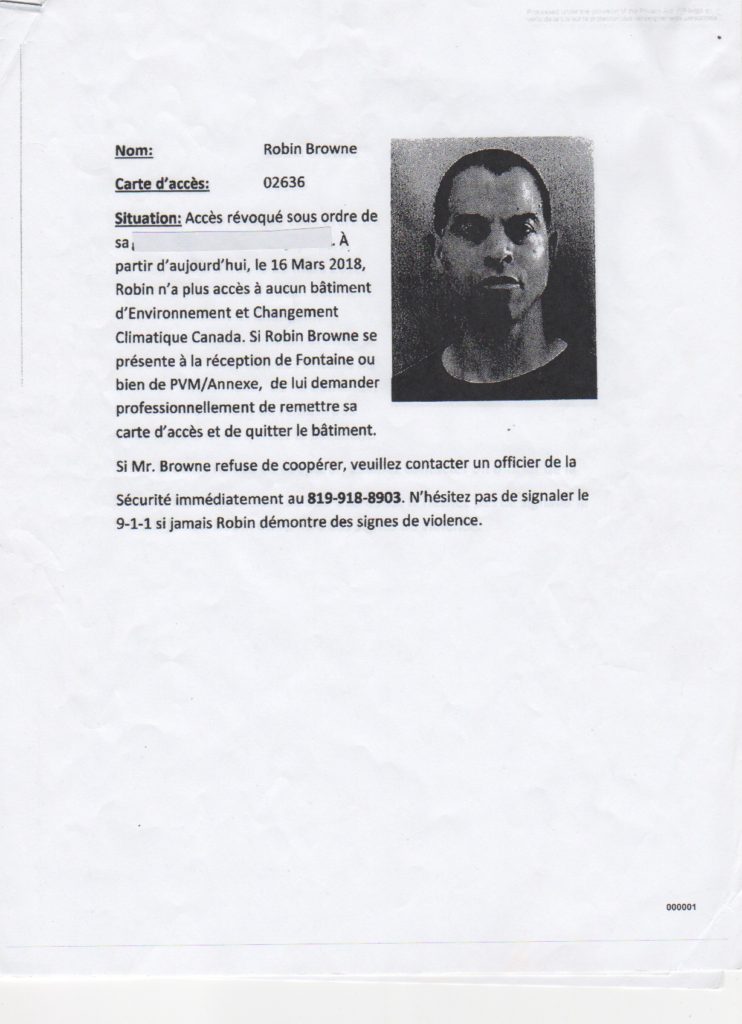
My union representative, who was at the meeting, told me that I had no choice but to do another medical exam, and leave immediately, or my bosses would have me escorted out by security. I left immediately and was off work for about a month. During that time, my manager, without informing me, and with the support of the director general, had me officially banned from all ECCC buildings and circulated the poster below to all ECCC security guards.

It says, “Access revoked by order of XXX. As of today, March 16, 2018, Robin no longer has access to any Environment and Climate Change Canada buildings. If Robin Browne presents himself at reception of [any ECCC building], ask him professionally for his access card and to leave the building. If Mr. Browne refuses to cooperate, please contact a security officer immediately at 819-918-8903. Don’t hesitate to call 911 if ever Robin shows signs of violence.”

I got what I now call my “mugshot”, through Access to Information. I also contacted my Member of Parliament and Environment Minister Catherine McKenna’s office and told them everything that had happened. I told them that since Prime Minister Trudeau had recently become the first Prime Minister to acknowledge systemic discrimination and anti-Black racism exist in Canada, including citing the lack of support for Black people with mental health issues, banning Black guys with depression from ECCC buildings, on false pretenses, was pretty bad optics.

A few weeks later my formal work action plan, and the manager who had imposed it, were gone and I was back working in the buildings from which I had been banned, as if nothing had happened.

There is more to tell, but that will come in later posts. Let me end this one by saying that I have continued to question discriminatory treatment of myself and my colleagues and the response like I describe above has continued non-stop. Let me also say that I am co-founder of the Federal Black Employee Caucus (FBEC) currently organizing to help the government fulfill the Prime Minister’s commitments and the attendance, and stories shared, at our meetings clearly show my story is disturbingly common in the federal public service.  I co-founded FBEC in December 2017, just months before the non-stop harassment began.

But maybe it’s just a coincidence…

Note: The opinions expressed here are my own and do not necessarily reflect those of the Federal Black Employee Caucus. To contact an FBEC spokesperson use the Contact Us page on FBEC’s website.

Categories
613-819 Black Hub National Black Canadians Summit

Help send two Ottawa Black youth to the National Black Canadians Summit

******* UPDATE March 18 ******

We had to cancel the fundraising campaign as the Summit was canceled due to the coronavirus pandemic. When the Summit is back on, the campaign will be too!

****************************************

From March 20-22, Canada’s Black communities will converge in Halifax to celebrate the history of Black Nova Scotia and gather for the 3rd National Black Canadians Summit (NBCS). This year’s Summit is youth-led and youth focussed.

Help the voice of Ottawa’s youth be heard!

The 613/819 Black Hub is raising money to send two young people from an Ottawa community to the Summit so they can share their valuable knowledge and experience and learn from others.

The Summit is fast approaching (and we just came up with this idea) so we need your help ASAP!

Donate here: 613-819 Black Hub NBCS youth fund GoFundMe page

Together we grow stronger.

Categories
FBEC Self-advocacy Unions

Tales from the Plantation #3

When I tell people my stories captured in TFTP 1&2 they’re always shocked and often say, “Oh, I’m so sorry you’re going through this!”

Whenever someone says that, I always think it would be like saying it to the students who helped launch the US civil rights movement, violating Jim Crow laws by simply asking to be served at a restaurant. Despite being screamed at, hit and doused in hot coffee, I’m pretty sure those students would have responded the same way I do: “No need to feel sorry for me. This is the price of change.” Every successful social movement needs a steady stream of people willing to challenge the system head on to draw it out in the open. This is even more true in Canada in 2020 where we are fighting anti-Black racism and white supremacy cloaked in myths of how “Canadians are all so polite”. Most Canadians are polite – until someone or something threatens their real, or perceived, power or privilege – then we see Mr. or Ms. Hyde emerge in all sorts of colors.

But I’m not encouraging martydom. Hell no. We need you to stay alive, healthy and in the fight. However, the established channels for fighting back in the federal public service – talking with one’s manager, or filing departmental harassment complaints or union grievances are, for the moment, very limited in their effectiveness. Therefore, here are the some things I’ve used to fight back:

  1. Access to Information and Privacy requests – as I said in TFTP#1, I got my mugshot via Access to Information (ATIP) and have gotten other invaluable evidence of discrimination that way. ATIP is cheap and fast. All you need do is go on the ATIP site and pay $5 for a request for general documents. If you’re looking for things specifically about you, you can make a privacy request on the same site for free.
  2. The Canadian Human Rights Commission (CHRC) – As I said in TFTP#2, I filed a complaint against Environment and Climate Change Canada with the CHRC. In the early stages, the Commission did something that no one else had, up to that point: they asked my manager for explanations of the things in my story. Although my complaint is now stuck for the next two years awaiting a decision, it still has impact. No department wants to be seen to be violating people’s Charter rights. Also, should the Commission refer your case to the Canadian Human Rights Tribunal then, win or lose, the entire version of your story gets posted on the internet. It’s kind of like having your day in court – then having them post the entire transcript online. #exposed
  3. Small claims court – also in TFTP#2, I said I was suing the investigator my former manager hired, for libel, in small claims court. Like ATIP, small claims court is cheap, compared to regular court. It has cost me about $500 so far and the next step is a “settlement conference” at which I’ll get to plead my case before a judge, with me as the plaintiff and the white guy I’m suing as the defendant. This is powerful because, systemic discrimination requires chains of people to support actions that protect the system and, therefore, their own power and privilege. As public servants, we don’t have the right to sue any of our public servant managers in the chain but we can sue 3rd-party contractors. As word spreads that Black people are suing 3rd-party contractors who participate in discriminating against them, that weakens the chain.

None of the established processes for fighting back have led to anyone being held accountable for anything they’ve done to me or to any Federal Black Employee Caucus member as far as I’m aware. The methods above have.

The unions, in which I always had great faith, until now, have done almost nothing for me or any FBEC member I know. This is due to a number of factors:

  1. The union reps have little training dealing with anti-Black racism.
  2. The union reps have massive workloads and are told to prioritize cases where people are facing imminent termination, and sexual harassment cases.
  3. Union reps recommend solutions involving “3rd-party” mediators that aren’t 3rd party. In my case, that was ECCC’s former Office of Conflict Management (OCM) that my union rep said was supposed to act as an unbiased mediator between employee and employer. After finding the OCM process painfully slow, I did some checking and learned that the OCM was, in fact, run by Labour Relations that also represents management. I guess that’s why they called it the Office of Conflict Management and not the Office of Conflict Resolution.

FBEC is working with the union management to get the unions to do their jobs but, in the meantime, people need tools that work, so please share this post.

Note: The opinions expressed here are my own and do not necessarily reflect those of the Federal Black Employee Caucus. To contact an FBEC spokesperson use the Contact Us page on FBEC’s website.