Categories
Human rights Minority Report

Minority Report #2: Carney sidelines human rights in first 120 days

The biggest takeaway from the first 120 days of Mark Carney’s Liberal government is the almost complete absence of any concrete mention of human rights. As I said in my post Minority Report #1, the Speech from the Throne, which outlines the government’s priorities, doesn’t explicitly mention human rights. It simply says, “The Government will always protect the rights and freedoms that the Charter guarantees for every Canadian.” The government’s priorities, as stated in Prime Minister Mark Carney’s mandate letter, are:

  1. Establishing a new economic and security relationship with the United States and strengthening collaboration with reliable trading partners and allies.
  2. Building one Canadian economy by removing barriers to interprovincial trade and expediting nation-building projects.
  3. Bringing down costs for Canadians and helping them get ahead.
  4. Making housing more affordable by unleashing public-private cooperation and catalysing a modern housing industry.
  5. Protecting Canadian sovereignty and keeping Canadians safe by strengthening our Armed Forces, securing borders, and reinforcing law enforcement.
  6. Attracting the best global talent while returning immigration rates to sustainable levels.
  7. Spending less on government operations so that Canadians can invest more in people and businesses.

This is in stark contrast to the Trudeau government that explicitly mentioned human rights in the 2019 and 2021 Throne speeches and, in May 2023, announced Canada’s bid for a seat on the United Nation Human Rights Council for the 2028-2030 term.

This omission supports the argument that Canada faces a human rights credibility gap due to its domestic human rights record. That argument was advanced in the July 30, 2025 Policy Options article Canada’s foreign policy credibility begins at home. For the article, the four authors, all graduate students at the University of British Columbia’s School of Public Policy and Global Affairs, interviewed dozens of officials and civil society leaders. They found, “Canada’s human rights record looks strong on paper, but the reality is more complicated. We have ratified numerous international human rights treaties, such as the International Covenant on Civil and Political Rights and the International Convention on the Elimination of All Forms of Racial Discrimination. But those commitments rarely make it into enforceable domestic law. Canada’s dualist legal system means international treaties require domestic laws to be enacted to give the treaties legal force at home. Without that, they remain aspirational.”

The authors detail issues with Canada’s domestic human rights system including lack of transparency in human rights reporting, data accessibility and weak enforcement. They said, “Interviewees consistently called for stronger accountability mechanisms. Some proposed legislation to mandate follow-up on UN recommendations or to establish an independent co-ordinating body with real authority.” They ended by saying, “Human rights can’t remain a bureaucratic side project buried in intergovernmental committees. Federal leaders must set clear expectations for provinces and territories, give oversight bodies true power and — most importantly — show Canadians and the world that they are willing to be held accountable.”

It would also be a good idea to not pass laws like Bill C5 which Ecojustice says, “erodes democratic principles, runs roughshod over Indigenous rights, shuts Canadians out of decisions that could affect them, and puts the environment at risk.” One of the most controversial parts of Bill C5 is the powers it gives the government to fast track projects it determines are of “national interest.”

The Assembly of First Nations held national discussions on Bill C5 ten days before it became law. “During the discussion, Chiefs raised strong concerns over the rushed legislative process, lack of meaningful consultation, narrowly defined national interest that excludes First Nations priorities and perspectives…and the broader implications for rights and jurisdiction.” The meeting also featured a First Nations political panel featuring B.C. Regional Chief Terry Teegee; the Honourable Jody Wilson-Raybould, former Minister of Justice and Attorney General of Canada; and former National Chief Ovide Mercredi. “Speakers emphasized that Bill C-5 represents a significant step backward in the Crown–First Nations relationship and questioned the federal rationale to once again sidestep their obligations to First Nations rights holders. They noted that the concept of “national interest” must include the rights of First Nations as original stewards of the land. Speakers stressed that the Bill stands in contrast to what First Nations have long advocated for, and conflicts with Canada’s own laws, including the United Nations Declaration on the Rights of Indigenous Peoples Act.”

So Carney is doing things which Indigenous people see as directly attacking their human rights – and saying absolutely nothing about the human rights of Black Canadians. This is also in stark contrast to Justin Trudeau who was the first Prime Minister to acknowledge the existence of systemic anti-Black racism in Canada and whose government formally recognized the UN Decade for People of African Descent. The Trudeau Liberals also committed to including Black folks as a distinct group under the federal Employment Equity Act and launched Canada’s Black Justice Strategy.

Luckily, history has shown that fundamental change for Black folks has always come from Black folks’ resistance. So some Black folks aren’t waiting for Mark Carney to show he cares about Black Canadians – they’re taking action now. One tool of resistance available to Black folks (and all folks) is filing human rights complaints with the Canadian Human Rights Commission and its provincial counterparts like the Nova Scotia Human Rights Commission and the Human Rights Tribunal of Ontario. Such complaints are potentially powerful as the Commission/Tribunal has the power to order the target of the complaint to respond – and the person filing the complaint doesn’t have to pay anything, including legal fees as no lawyer is required. The problem is that it can take years to get a result due to huge backlogs at the Commission/tribunals. If Carney really cares about human rights he’ll provide adequate funding to the Canadian Human Rights Commission and the Canadian Human Rights Tribunal to allow them to deal with complaints in a timely manner.

According to the office of my Member of Parliament, Liberal Anita Vandenbeld, Carney’s government still has aspirations of a UN Human Rights Council seat and is maintaining Canada’s bid. Canada also said it intends to recognize the State of Palestine at the 80th Session of the United Nations General Assembly in September 2025, with some conditions, which would be a huge step in supporting the human rights of the Palestinian people. However, Canada must ensure things are right in its own human rights house before seeking a leadership role on the international stage.
Categories
CHRC HRTO Human rights

Black human rights matter

Fighting discrimination in court is long and expensive. So it’s good we have the Canadian Human Rights Commission. Or is it…? The Canadian Human Rights Commission is Canada’s national human rights institution. Or, at least that’s what it was supposed to be… 

The Canadian Human Rights Commission was established by Canada’s Parliament in 1977 with a mandate to promote and protect human rights. The Canadian Human Rights Tribunal was created in 1998. The Commission investigates and screens complaints, and decides whether to send them to the Tribunal for a hearing. The Tribunal hears complaints referred to it by the Commission, and decides whether discrimination has occurred.

The Commission was supposed to be the place where people can seek justice if they feel they’ve been discriminated against based on one of the categories covered by the Canadian Human Rights Act such as disability, age or race. However, in September 2023, the Canadian Senate released a report titled Anti-Black Racism, Sexism and Discrimination in the Canadian Human Rights Commission. The report cited allegations of anti-Black racism raising concerns about the Commission’s treatment of its own employees, as well as its decision-making processes when dealing with complaints. The report said witnesses described a toxic culture at the Commission and provided specific evidence of systemic discrimination.

The issues at the Commission is one reason some Black groups have called for the federal government to adopt the direct-to-tribunal human rights complaint model like in Ontario, British Columbia and Nova Scotia. However, the Tribunal model has its own issues. In Ontario, one of the main issues is a backlog of complaints.

Tribunal Watch Ontario’s May 2024 report, The Human Rights Tribunal of Ontario: A Continuing Crisis, says that, “according to Tribunals Ontario’s most recent Annual Report, the HRTO backlog grew by another 500 applications over the 12-month period covered by the report, despite the fact that it received the lowest number of new applications since 2015/16. The HRTO’s unresolved caseload rose to 9,527, amounting to a three-year backlog. Equally alarming is the way the HRTO is now dealing with its backlog. Analysis of the Open Data Inventory on the Tribunals Ontario website reveals that an unprecedented 96% of all final HRTO decisions in 2023/24 were “jurisdictional or procedural” dismissals of applications, without the applicant having an opportunity to make oral submissions or attempt mediation. Most of these dismissed applications had been stuck in the HRTO backlog for years. Almost 80% of “jurisdictional or procedural” dismissals are based on a finding that the applicant abandoned the application, but a review of 2024 dismissals based on abandonment reveals the overwhelming majority are applications that were filed by unrepresented applicants three or more years previously. In many cases, it appears that the application was dismissed after the applicant failed to meet a newly- imposed filing deadline that seemed to follow years of HRTO inactivity on the file. What this record indicates is that, if the tribunal fails, over multiple years, to effectively move applications towards resolution, it can count on a significant number of applicants giving up, or being unable to continue to pursue their claim, especially when the vast majority are not represented by a lawyer.”

The preamble to Ontario’s Human Rights Code declares that “it is public policy in Ontario to recognize the dignity and worth of every person and to provide for equal rights and opportunities without discrimination that is contrary to law”. Ontario’s Human Rights Tribunal is now conducting itself in a manner that is contrary to the public policy enshrined in the Code, by allowing delays and backlogs to undercut access to enforcement of the right to live without discrimination.

The Tribunal’s issues disproportionately impact Black Ontarians who face disproportionate levels of poverty and thus need access to justice that doesn’t always require hiring a lawyer.

But delays caused by an under-resourced Tribunal isn’t the only issue. Another issue is the Tribunal requiring Black people who file complaints, called “applicants”, to produce proof of explicit racism, despite the Tribunal acknowledging racial discrimination is often subtle. 

For example, in the 2007 case of Nassiah v. Peel (Regional Municipality) Services Board, the Tribunal ruled in favor of Jacqueline Nassiah, a Black woman, who filed a complaint against a Peel Regional Police Service officer for the way he treated her during his investigation into an allegation that she had stolen a bra from a Sears store. The Tribunal adjudicator said she based her decision partly on the fact the officer asked whether Ms. Nassiah spoke English “in part because she is Black”, called her a “fucking foreigner” during the investigation and threatened to take her to jail if she did not produce the bra. The discrimination Nassiah faced was unusually explicit.

In contrast, in the 2008 case of Sinclair v. London (City), the Tribunal ruled against Vincent Sinclair, a Black man, who filed a complaint after a dispute at London, Ont. City Hall which led to someone calling a security guard who escorted Sinclair out of the building and called the police on him. At least two City Hall employees said Sinclair “raised his voice” and “pounded his fist on the counter.” In his ruling, the Tribunal adjudicator said, “In this case, the question is whether, on a balance of probabilities, the complainant [Sinclair] and [the Ontario Human Rights] Commission have proven that the evidence supports a finding that race was a factor in the involvement of security. I find that this has not been proven…On balance, the evidence supports the non-discriminatory explanation that the City has suggested, that the call resulted only from Mr. Sinclair’s behaviour.”

The adjudicator found this despite saying this earlier in his decision in response to expert testimony of Frances Henry, a York University Department of Anthropology professor and an expert on various issues of race and racism, including racial profiling, race and the media, and race and the criminal justice system:

“I accept from Dr. Henry’s evidence that race is a factor in many social interactions in our society. Racialization affects Black men in particular, often without the conscious involvement of those making decisions, through stereotypes of them as physical, violent, and more likely to be criminal. This may lead to heightened monitoring and racial stereotyping.”

The fact that the adjudicator didn’t recognize that systemic discrimination means that race is always a factor is a problem. And this leads to the final issue with Tribunals: the lack of race-based data on Tribunal rulings. Here’s what ChatGPT said in reply to the question “Is there disaggregated race-based data on Human Rights Tribunal of Ontario decisions?”:

Disaggregated race-based data on decisions by the Human Rights Tribunal of Ontario (HRTO) is not routinely published or systematically available. If you’re interested in such data for a specific purpose, it might be necessary to:

  • Conduct independent research by reviewing HRTO decisions.
  • File a formal request for data through Freedom of Information mechanisms, if the HRTO collects race-based data not publicly available.
  • Consult existing studies or analyses on HRTO outcomes, as some researchers or organizations might have undertaken this work.

In Sinclair’s case, the adjudicator found that Sinclair failed to prove, on a balance of probabilities, that race was a factor in people calling security on him. But most Black folks reading this case would ask the same question: would they have called security on him if he was white? But we can’t know the answer to that until we start consistently adding the category “white” to all our data collection systems.

London City Hall staff no doubt have a system for tracking incidents like Sinclair’s. If staff had been required to start collecting race-based data, including the category “white”, in 2008, they would now have 16 years of data helping to answer the question “would they have done the same thing if the person was white?”

Other decisions, like McDonald v. CAA South Central Ontario, 2018 HRTO 163, also show that applicants can be successful by arguing to the Tribunal’s satisfaction that it’s more probable that the treatment they faced was discrimination because on their race (or age, disability, etc.) than the non-discriminatory reasons provided by the respondent. This should be easy to do in cases where perpetrators of discrimination provide justifications that make no sense or are easily provable lies. However, in cases like Sinclair, where the justification seems just (i.e. he was getting aggressive), we need data to prove whether white people doing similar things are being treated the same – and that requires consistently adding the category “white” to forms that track race.

Tribunals could offer an affordable, powerful path to justice for Black folks if they’re properly resourced, make decisions based on the probability of discrimination instead of explicit evidence of it and produce publicly available race-based data, consistently including the category “white”, on their rulings

This is good advice for the federal and provincial governments because, you know what they say: no justice, no peace.

Categories
Human rights World Cup

Profit trumps human rights at Qatar World Cup

Like millions of others I have been glued to my TV watching my country play in the Fifa World Cup in Qatar. However, watching the World Cup has felt similar to when I watched Game of Thrones and The Walking Dead: I have enjoyed it while also being struck by the huge problems with the whole thing.

Fifa awarding the World Cup to Qatar raised the question: how bad does a country’s human rights record have to be to disqualify it from hosting? 

Qatar is a non-democratic, country that has been ruled by the House of Thani family monarchy since Mohammed bin Thani signed a treaty with the British in 1868. In early 2017, Qatar’s total population was 2.6 million, with 313,000 of them Qatari citizens and 2.3 million expatriates. Eighty-eight per cent of the population are foreign workers, mostly South Asians, with those from India alone estimated to be around 700,000. Egyptians and Filipinos are the largest non-South Asian migrant group. The treatment of these foreign workers has been heavily criticized with conditions suggested to be modern slavery. 

This isn’t the first time Fifa, the global football governing body founded in 1904, has awarded the World Cup to a country with a horrible historical and ongoing record of human rights violations. The 1934 World Cup was held in Italy during the reign of fascist dictator Benito Mussolini, an ally of Hitler. The 1978 World Cup was in Argentina when military officer and dictator Jorge Rafael Videla was president. Wikipedia describes Videla’s reign as “among the most infamous in Latin America during the Cold War, due to its high level of human rights abuses and severe economic mismanagement”. And the 2018 World Cup was in Russia when Vladimir Putin was in power – and had invaded Crimea in 2014.

And just as we can ask how bad a country’s human rights record has to be to be disqualified from hosting the World Cup, we can also ask: how bad does it have to be for countries to boycott the event? 

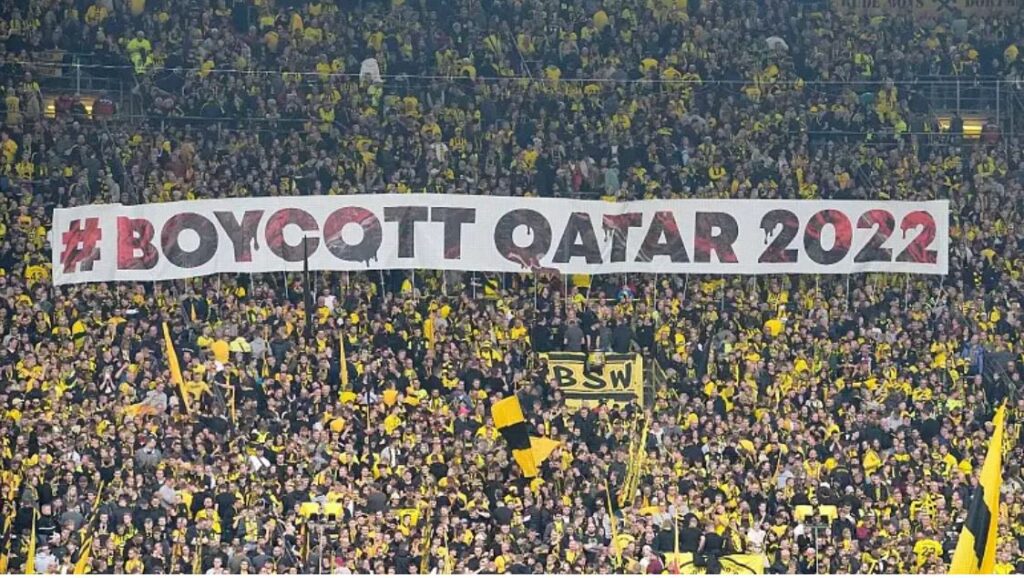
Clearly, no country found Qatar’s human rights record bad enough to boycott the World Cup. Norway and Germany’s governing football bodies considered boycotts that they decided against in the end. (Norway’s decision was made easier by Norway failing to qualify for the tournament.) In Germany, this was despite a strong boycott movement that saw fans hoisting huge #Boycott Qatar 2022 banners at German Bundesliga matches.

German fans hoist banner at German Bundesliga game in October 2022

Qatar hosting the World Cup also raises other questions, including: are some human rights more valued than others and do human rights vary country to country? The answer to both questions seems to be a clear yes.

Homosexuality is punishable by death in Qatar (so they probably won’t be hosting the women’s World Cup anytime soon given openly gay superstars like Canada’s Christine Sinclair and American Megan Rapinoe). And Fifa didn’t just tacitly support Qatar’s state-sanctioned homophobia by awarding Qatar the World Cup. It also threatened seven teams whose captains vowed to wear OneLove arm bands with sanctions if they did. The OneLove armbands were originally launched in 2020 as part of an inclusiveness campaign by the Royal Dutch Football Association (KNVB). Reuters reported that the KNVB campaign opposes discrimination on the basis of race, skin colour, sexual orientation, culture, faith, nationality, gender, age and “all other forms of discrimination”. Captains from England, Wales, Belgium, the Netherlands, Switzerland, Germany and Denmark were planning on wearing the armbands to protest Qatar’s laws against same-sex relationships. Fifa threatened to issue yellow cards to any player wearing the armband which could have led to them missing games. All seven teams abandoned their plans.

Some may wonder if Fifa is putting profits above people and considering Fifa recently said it has made $7.5 billion from World Cup commercial deals over the last four years, that appears to be the case. But it’s not only Fifa that put their morals on hold. The sponsors behind those commercial deals – including Adidas, Coca-Cola, Hyundai-Kia, Visa, Anheuser-Busch InBev and McDonalds – have all also apparently chosen profits over people. This is despite companies like Coke issuing statements like Coke’s 2019 How Coca Cola Supports Inclusion and Equality for the LGBTQ+ Community.

The thousands of fans attending in person also decided it’s OK to turn a blind eye to Qatar’s human rights policies and pump millions into the already rich Qatari economy. Will they also continue buying sponsors’ products with this massive stain on those companies’ claims of LGBTQ+ support? And, if they do, what incentive will those companies have to change their behaviour? Clearly, very little…

Another issue is that, although the Qatar World Cup has exposed how capitalism values profit over people, almost every World Cup exposed how unequally those profits are distributed. 

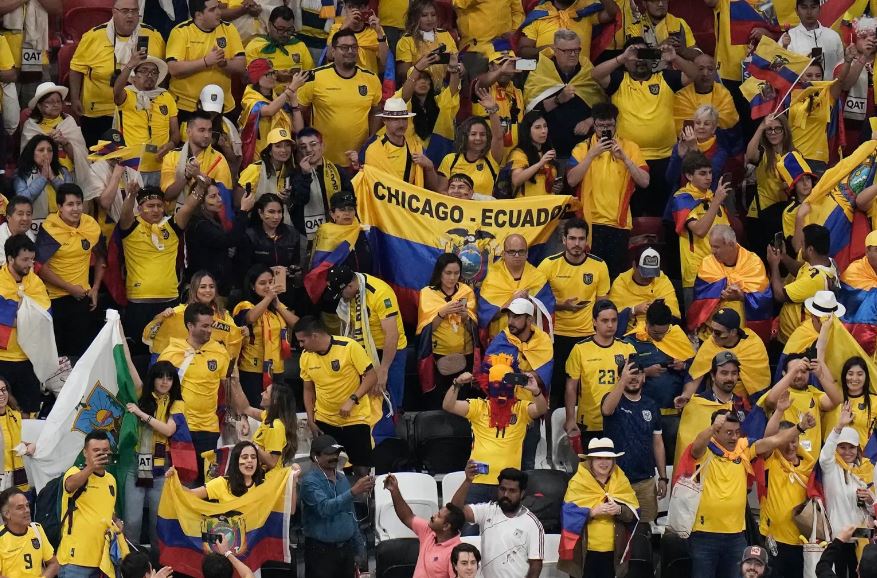
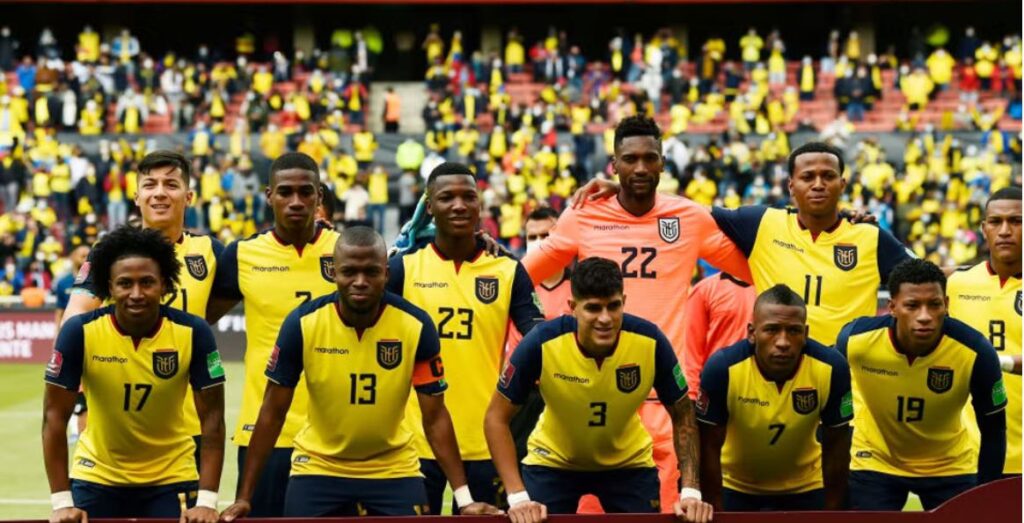
Watching the World Cup one is struck by how many Black faces there are on the field vs Black faces in the stands. This is particularly striking for countries like France, Ecuador and  especially Brazil – where over half the population is Afro-Brazilian – but there’s barely a Black face to be seen among the country’s World Cup fans. Attending any World Cup is expensive so the colors of a country’ fans give some indication who has the money in those countries.

Ecuador World Cup team
Ecuador World Cup fans

Fifa’s actions aren’t that surprising as, since Fifa awarded Qatar the World Cup in 2010, more than half of the 22 members of the FIFA Executive Committee which voted for Qatar have either been implicated in or investigated for alleged corruption or other bad practices, according to DW.com.

It would be great if football fans used their collective power to demand that Fifa do things like adopting the principle that if it wouldn’t award the women’s World Cup to a country because of human rights issues, it shouldn’t award that country the men’s World Cup either. 

North American activists will no doubt ensure that the human rights records of Canada, the U.S. and Mexico will be highlighted in the run up to the 2026 World Cup – and well they should, because clearly Fifa won’t.