Categories
Copaganda Police

Copaganda helps fuel perpetual police budget increases

One of the main reasons city councils throughout the US and Canada approve big police budget increases every year is copaganda. According to Wikipedia, copaganda is “propaganda intended to shape public opinion about police or counter criticism of police and anti-police sentiment.” But that describes the intent of only one main source of copaganda: the police. The authors of other sources, including the mainstream media, TV shows, movies and books don’t, for the most part, intend to shape public opinion about the cops.

The mainstream media reinforces copaganda by uncritically reporting police press releases like stories about Ottawa police launching a body camera pilot that didn’t include any critical voices citing all the studies showing body cameras don’t reduce police violence.

Cop pop culture products aren’t explicitly meant to influence public opinion, they’re meant to entertain and make money. Whether they make people like cops more is debatable. What isn’t is that they cement racial attitudes, normalize bad police behavior and impede changes to policing in real life, as revealed by a report cited in a June 2020 National Public Radio story. Color of Change, which advocates for racial justice, teamed up with the University of Southern California’s Norman Lear Center on the study which looked at 26 cop shows and more than 350 episodes, across the 2020 season. It found that, with few exceptions, the shows rarely depicted how disproportionately Black people are targeted by police or how bias is baked into this system. Also, over and over again, the good guy – the police officer, the district attorney – was doing bad things. And it was being endorsed.

Wikipedia quotes The Daily Dot’s Brenden Gallagher saying, “The media has been regurgitating police PR since the days of Andy Griffith and now in the era of Brooklyn 99, it is just being used more often and more effectively.” The Andy Griffith Show was an American sitcom TV series that aired on CBS from 1960 to 1968. It starred Andy Griffith as Andy Taylor, the widowed sheriff of Mayberry, North Carolina, a fictional community of roughly 2,000–5,000 people. Brooklyn 99 is an American police sitcom television series that aired from 2013, to 2021 and starred Saturday Night Live alumnus Andy Samberg.

“Aaron Rahsaan Thomas comments on the history of copaganda in American television: “The past 60 years have seen shows like Dragnet (1951–1959), The Untouchables (1959–1963), and Adam 12 (1968–1975) establish a formula where, within an hour of story, good law men, also known as square-jawed white cops, defeat bad guys, often known as poor people of color.” Subsequent shows such as Hawaii Five-O (1968–1980) and Kojak (1973–1978) solidified this narrative, along with Hill Street Blues (1981–1987), Miami Vice (1984–1989), and Cagney & Lacey (1982–1989), which were “for the most part, told from the point of view of white cops occasionally interacting with people of color who were, at best, one-dimensional criminals, colleagues, bosses, sidekicks, and best friends. Even when blackness was not equated with criminality, it was often supplemented by an inhuman lack of depth or presence.” 

In my post Why white people can’t wait for the zombie apocalypse, I talked about how the main character of the massively popular series, The Walking Dead, was Rick Grimes, a sheriff from a small Georgia town who didn’t seem to have a racist bone in his body – he even hooked up with the show’s bad ass Black female character!

Detective novels (which I, a police abolitionist, ironically read for escape) are rich sources of copaganda. James Patterson’s book covers declare him the world’s bestselling author. Patterson created characters like serial-killer hunting detective Alex Cross. This passage from Patterson’s 2020 novel Blindside is a classic example of copaganda. It’s narrated by NYPD Detective Michael Bennett after he has just shot and killed a young Black man who pulled a gun on him while mugging him:

“All I knew at the moment was that I couldn’t leave the scene. I just wanted to sit here with my thoughts. Silently I prayed, Dear God, have mercy on this young man’s soul. I thought about calling my grandfather, Seamus. Then I heard someone shout, “He did it.” It didn’t register immediately. Then someone else said it. I looked up and over my shoulder to see a small group of people facing me. A heavyset African American man of about thirty-five pointed at me and shouted, “That cop shot RJ for no reason. He murdered him.” I let him talk. It never did any good to speak up. People had to vent. This neighborhood had fought to shed its reputation from the 1980s. Crime, especially homicides, was down. Cops could only do so much. Neighborhoods and the people in them had to decide to change. And this one had. I could understand some misplaced anger over a shooting. The vast majority of cops try to do the right thing. That’s why they get into the business. A few go overboard. And like anything else, most groups are judged by the actions of a few. It’s been like that since the dawn of time. I recognized that prejudgment was contributing to this crowd’s growing fury. They were pissed off. Right now they were pissed off at me. I just took it. My heart fluttered and my hands shook.”

In addition to trying to make the cops look good, copaganda also aims to make cops’ critiques look bad. To that end, just after this scene, Patterson introduces an Al Sharpton-like character called Reverend Caldwell who the pro-police characters say only advocates for people who have been harmed by police…because he gets a cut of their settlements. (Like so often in real life, they provide no evidence of this.)

The earliest copaganda I remember watching is Get Smart, a comedy about a bumbling, James Bond-like character named Maxwell Smart. Smart worked for CONTROL, a secret US government counterintelligence agency based in Washington, D.C., that battled KAOS, an evil international organization. (This foreshadowed North American police forces referring to themselves as the Thin Blue Line between the “chaos” of violent crime and criminals and all the “good” people who obey the law.)

Sesame Street had several police characters, including Officer Krupky, a Muppet cop who appeared on the show during the 1970s and Kermit the Frog appearing as Detective Amphibowicz in NYPD Green, a Muppet parody of the TV show NYPD Blue.

Westerns were also an early form of copaganda with most Sheriffs being portrayed as white, male guardians of good. (Although, some also glorified bad guys like Jesse James.) 

The Simpsons has Chief Clancy Wiggum, chief of police in the show’s setting of Springfield. Although Wiggum is portrayed as gluttonous, irresponsible, immature and often too lazy, cowardly, and corrupt to bother fighting crime, his character isn’t a critique of the institution of policing as Wiggum has two more responsible subordinate officers, Eddie and Lou.

In 2020, following the police murder of George Floyd and the resulting protests, audiences in the US and elsewhere demanded increased attention to how police were portrayed in crime shows and other media. This resulted in the cancellation of some programs such as the reality TV show Cops and A&E‘s Live PD.

In my post Why Afrikan Canadians should become data warriors, I wrote about how the police create their own copaganda using misleading statistics like the Crime Severity Index and the police to population (cop-to-pop) ratio that support the myths that violent crime is rising and that having more police per 1000 people in the population increases safety (neither is true).

Ottawa’s police chief adds to the virtually non-stop flood of copaganda by regularly ending his verbal reports to the monthly meetings of the Ottawa Police Service Board with feel good stories about Ottawa police officers helping citizens in need. Sometimes he reads grateful citizens’ own letters. However, the Chief never says whether the happy citizens’ are white, Black or anything else. Evidence suggests they’re likely the former.
At a time when so many Ottawa residents are struggling to make ends meet, Ottawa Mayor Mark Sutcliffe wants to give the police their biggest budget increase in 15 years. Despite all the evidence proving that investing more in police doesn’t increase safety, copaganda will help ensure that the Ottawa Police Service Board and Ottawa city council will vote to give the police every dollar they ask for – before they head home to unwind with an episode of Law and Order or Blue Bloods.
Categories
Housing Police

The thin blue line between housing and policing

At the end of 2024, I decided to shift a chunk of the work I do on policing to housing – and immediately began learning the links between the two.

The first link is the close connections between the Multifaith Housing Initiative (MHI) and the Ottawa Police Service (OPS). MHI’s website says MHI “exists to build affordable housing that helps fix Ottawa’s housing crisis and gets at-risk people into secure, safe homes”. What I couldn’t find on MHI’s site was any mention of MHI being one of two recipients of funds raised through the13th Annual Ottawa Police Gala, held November 2, 2024 in Ottawa. 

Sahada Alolo, MHI’s Director of Community engagement, is the Community Co-Chair of the Ottawa Police Service Community Equity Council and the Co-Secretariat Director of the Guiding Council on Mental Health and Addictions which the Ottawa police created and on which the OPS sits.

Then there’s Herongate, a large rental neighbourhood in Ottawa which is owned by multi-billion-dollar real estate investment firm, Timbercreek Asset Management. Around 800 people — predominantly lower-income, racialized households — have been demovicted and displaced from the neighbourhood since 2016, leading to the emergence of the Herongate Tenant Coalition to fight the evictions and confront Timbercreek. 

Suzanne Valiquet, Timbercreek’s former public relations consultant and overseer of tenant relocation in Herongate, served multiple terms on the Ottawa Police Service Board, including as Chair. According to Andrew Crosby’s 2023 book about Herongate, Resisting Eviction, court documents spotlight her relationship with Ottawa police and Timbercreek. On October 4, 2018, a 911 call was made from Timbercreek’s office requesting police assistance to disperse a tenant rally. Emails written by Valiquet to Timbercreek officials indicate that she received advice directly from the chief of police (Charles Bordeleau at the time) on how to escalate the police response: “At 5:39 pm I called 911. I called a second time (on the advice of the Chief of Police). This way our call went from a priority 2 to priority 1 emergency call. Six police officers arrived around 6:03 pm”. Valiquet further indicated that the police officers advised her to continue to call for assistance if there were future demonstrations, noting that “the more times you call the bigger the file against [them] will grow.”

Ottawa Police Services Board member, Ottawa city councillor Cathy Curry, is also on the Planning and Housing Committee. Decisions about housing policy—such as zoning, development approvals, and funding allocations—are deeply interconnected with the lived realities of over-policed communities. Curry’s dual role raises questions about potential conflicts of interest and whether community voices are adequately represented in these critical discussions.

In November 2024, real estate lawyer Michael Polowin was appointed to the Ottawa Police Service Board, raising more concerns about links between those shaping Ottawa’s housing landscape and those overseeing policing. When individuals with vested interests in real estate development are placed in positions of police oversight, it risks further prioritizing corporate and development interests over community well-being.

The CEO of Ottawa Community Housing, Ottawa’s largest provider of community and affordable rentals in Ottawa, Stéphane Giguère, is on the Board of Crime Prevention Ottawa with Ottawa Police Service Chief Eric Stubbs. Crime Prevention Ottawa says it contributes to crime reduction and enhanced community safety in Ottawa through collaborative, evidence-based crime prevention. On July 12, 2023, Ottawa city council approved the merger of Crime Prevention Ottawa (CPO) with the City’s Community Safety and Well-Being office “for a more cohesive, integrated approach by the City to crime prevention.”

Another link between housing and policing is the disproportionate amount of funding spent on both.

In its 2025 budget, the City of Ottawa committed $22.9 million to develop more affordable and supportive housing for residents in greatest need. In the same budget the City gave the Ottawa police budget a $16 million increase, bringing the OPS net operating budget to $388.7 million.

However, while there is ample evidence of the benefits of investing in affordable housing, the same cannot be said for policing. In its 2017 report, Understanding the Benefits of Investments in Affordable Housing, the Canadian Centre for Economic Analysis says:

“Investment in affordable housing provides substantial economic benefits at both the local and regional levels (provincial in Canada or state in the U.S.). Investment in affordable housing has the potential to generate new jobs, wages and salaries, economic activity, and government revenue due to the economic activity generated by the direct construction or revitalization itself, the indirect purchase or sale of goods or services upstream or downstream by firms directly involved in construction, and the induced activity that occurs due to the increased wages and salaries that these previous effects generate. Furthermore, at each of these steps, government revenue is generated through taxation, permits or fees required throughout the process.”

However, there’s no evidence supporting the claims of the police and their supporters that investing in policing achieves policing’s main stated goals: preventing and reducing crime.

There is, however, ample evidence that the police negatively impact racialized people all along the pre-school to prison pipeline. From their presence in schools that disproportionately harms racialized students to their disproportionate use of force and traffic stops against racialized residents, the police inflict harm on racialized residents on a daily basis. This harm contributes to the disproportionate involvement of racialized people in the criminal justice system – which can be financially crippling to people already financially marginalized. 

It’s hard to pay your rent…when you have to pay your lawyer.

Categories
Blackademics Blacktivists Mental health Police

Mental health Blackademics add to Blacktivist toolkit

My post How Blackademics and Blacktivists can support each other said producing research Blacktivists can use for advocacy is one of the main ways Blackademics can help Blacktivists. Another way Blackademics can help is by holding conferences to share that research.

Last week I attended a conference on the theme of Mental Health of Black Communities: Overcoming Obstacles, Bridging the Gaps where mental health Blackademics, mostly from North America, shared their research.

The lead organizer of the conference was Dr. Jude Mary Cénat, an Associate Professor in the University of Ottawa’s School of Psychology and Chair of the Interdisciplinary Centre for Black Health. Cénat is Director of the Vulnerability, Trauma, Resilience & Culture (V-TRaC) Research Laboratory, and holds the Research Chair on Black Health at the University of Ottawa. 

There were sessions on the problems with “color blind” approaches to mental health, the social determinants and racial issues affecting Black folks’ mental health, anti-Black racism in the child welfare system and lots more. (For more sessions, see the full conference program.) 

As a full time Blacktivist, my goal in attending the conference was to get direction on where to most effectively advocate to help improve Black folks’ mental health across Canada – and it didn’t take long to get what I came for! In his opening Wednesday keynote address, Achieving Black Mental Health Equity, Dr. Kwame McKenzie called for the creation of a federal Black Equity Act that would make Black equity a federally legal requirement. The call for such an act supports Blacktivists’ existing demand for the federal government to appoint a Black Equity Commissioner similar to the ones it announced for antisemitism and Islamophobia in the 2022 federal Budget. 

On Day 2, in her session Promoting Health Equity: Mental Health of Black Canadians. Mobilizing, Partnerships: Taking Steps Together for Supported Reintegration, Dr. Barbara-Ann Hamilton-Hench said Black communities need to challenge the federal Tri-Council to remove barriers to funding high quality research about and by Black people, and to fund Black researchers. The Canadian Institutes of Health Research (CIHR), the Natural Sciences and Engineering Research Council (NSERC), and the Social Sciences and Humanities Research Council (SSHRC) make up the Tri-Council funding agencies. They are the primary mechanism through which the Government of Canada supports research and training at post-secondary institutions and are supposed to support and promote high-quality research in a wide variety of disciplines and areas. This supports the work the 613-819 Black Hub had already begun regarding SSHRC. 

In 2021, we discovered the Ottawa Police Service attempting to continue to try to deploy more cops in the community under the guise of the Neighborhood Resource Team program, which is their latest name for “community policing”. The OPS NRT program had ballooned from $2.5 million and 18 officers in 2019 to over $11 million and 89 officers in 2021. And the OPS was leading an evaluation of the program that was pretty much guaranteed to conclude that the program was great and should be further expanded. The project started in fall 2019 when the OPS hired Carleton professor Linda Duxbury to lead it. After we found out about the project, we met with Duxbury and asked her why no Black groups were included in the project description for her project on the SSHRC website (SSHRC gave her almost $200,000 for the project). She said she had included Indigenous groups. As Duxbury had done a very flawed study of the Peel Regional Police’s School Resource Officer program, we brought that to the attention of the Ottawa police, who said the report was one of the reasons they hired Duxbury. We then filed a complaint with Carleton University’s Research Ethics Board who found no issues with Duxbury. Finally, we filed a complaint with SSHRC who also backed Duxbury. However, after we continued to press Duxbury to do proper research by including the voices of Black and Indigenous people in her NRT report, she and the OPS, instead, canceled the 3-year, $260,000 project. We then took a look at SSHRC’s website and found it appeared to have no research on defunding or abolishing the police but several problematic studies related to police reform. Professor Hamilton-Hinch’s call has reinforced our commitment to challenging SSHRC on these issues.

One problem frequently raised at the conference, but for which few solutions were offered, was the lack of Black mental health professionals. (There was a session called Innovative Training Programmes for Mental Health Professionals on Issues Related to Cultural Safety and Addressing Experiences of Racism, by Ribbon Rouge Foundation Programs Director Dr. Selina Kunadu-Yiadom which may have covered this but I didn’t attend it.) In one session, they did show a CBC article titled Black psychologists say there are too few of them in Canada — and that’s a problem featuring photos of Ottawa-based psychotherapists Helen Ofosu and Kafui Sawyer. However, they didn’t share the main point of the article which was Black mental health care professionals highlighting problems in the accreditation process for psychological professionals as a key barrier to getting more Black ones. The article cited how, to become an accredited psychologist in Canada, students need to be accepted into a graduate program at a post-secondary institution or an internship program. Getting into a program depends on having a faculty member agree to be their supervisor but Ottawa-based psychotherapist Kafui Sawyer pointed out that the faculties are predominantly white and the students they’re recruiting or the students they have in [their] program are also predominantly white. Ofosu and Sawyer have formed a Black psychology section of the Canadian Psychology Association, which will advocate for more diversity in the profession.

Another area where Black students may be facing systemic barriers is getting scholarships. I recently acted as an assessor for the Loran Scholarship. The $100,000 award has existed since 1988 but no one I recently asked had heard of it. I only found out about it last year when our son applied for it – and didn’t make it past the first step, so wasn’t interviewed. One of Loran’s managers asked me to be an assessor to diversify their assessor pool and the training session I participated in showed why. Out of about 60 people, I was the only Black man (there were two Black women) and there was no one who identified as Indigenous. In the question period, I asked what percentage of assessors were Black or Indigenous men. The Loran exec leading the session said she didn’t know but would get me the info. I assessed 37 applications, none of which identified as Black or Indigenous men. The Loran application doesn’t have a self-identification option so you must infer who’s Black or Indigenous from what they write. We need to share info about such scholarships to get more Black students to apply – and more Black assessors.

But Black students will only encounter scholarship or accreditation issues if – and it’s a big if – they manage to make it through a systemically anti-Black education system – and avoid being caught in the systemically anti-Black “justice” system.

On that note, two of the most glaring omissions at the conference were any mention of the impact of policing on Black mental health or the role – and responsibilities – of the Ontario government in addressing the issues raised.

Considering health is largely provincial jurisdiction, this omission was notable. As a full time activist, I came away with little direction on where to advocate, and what to advocate for, at the provincial level. The Ontario government recently created a new Black Equity Branch and hired a director so we plan to work with that person to identify and address the changes needed at the provincial level.

As for policing, the word “police” wasn’t mentioned once in the conference program and there was only one session focussed on justice, called Justice and Mental Health. The 90 minute breakout session had four presentations only two of which were actually about justice: one on restorative justice and one on criminalization of Black refugees. 

Having a conference on Black mental health without a strong focus on the impact of policing is like having a conference on Black physical health without a strong focus on poverty. Canadian police, including in Ottawa where I live and lead the 613-819 Black Hub, continue to kill, or be involved in the deaths of, Black people experiencing mental crises. People who aren’t in crisis – yet – continue to have their mental health negatively impacted by sometimes violent interactions with police. Young Black and Indigenous Ottawa activists are still dealing with the mental impact of the Ottawa police arresting them after they blocked an intersection in November 2020 to protest the acquittal of Ottawa police constable Daniel Montsion in the 2016 beating death of Abdirahman Abdi (the police charged 12 of the about 30 protesters – then “stayed” the charges for one year, which meant that if any of the young people caused any “trouble”, the charges could be immediately reinstated.)

Next conference it would be good to see some research on things like the impact of layered policing on Black mental health. In his March 2021 Spring Magazine article Layered policing’ expands police amid calls to defund, Jeff Shantz describes layered policing as, “In response to community calls to defund police and fund necessary social resources, cities across the country have instituted “layered policing.” From Lethbridge to Saskatoon to Kitchener-Waterloo, these moves would actually deploy more police throughout the community, and embed policing in everyday social life.”

In January 2021, in response to community calls for the police to get out of mental health crisis response, the Ottawa Police Service presented the Ottawa Police Services Board with its initiative to create an alternative mental health crisis response system. The OPS said they had brought together a group of partner organizations to lead the initiative called the Guiding Council. The only problem was, they hadn’t told some of the partner organizations, including the Ottawa Black Mental Health Coalition of which the 613-819 Black Hub was a member. 

After yet another public outcry at the OPS leading such an initiative, the OPS agreed to have it moved under the management of the City. However, instead of removing themselves from any leadership role in the initiative, as the public demanded, they did exactly the opposite and joined the Guiding Council which they weren’t on when they first created it. We later learned that the Guiding Council would, in consultation with the City, decide which community groups get $2 million dollars of the $3 million cut from the OPS’ requested $14 million dollar 2022 budget increase. 

The Guiding Council is yet another place where the OPS appears to be pushing for a mental health crisis response system that still has lots of police involvement and zero impact on their annual multi-million dollar budget increases. The OPS’ influence is already clear in the Guiding Council’s terms of reference which aims for a system that still sends cops, “when the crisis is linked to criminal activity”. Wouldn’t that include a situation like Abdirahman Abdi who people called the cops on because he was allegedly touching women in a coffee shop? And wouldn’t that still include a situation like Greg Ritchie, an Indigenous man who people called the cops on because they said they saw a man with a knife that turned out to be a ceremonial tomahawk? Yes it would. Abdi and Greg would likely end up just as dead under the system currently being proposed by the Guiding Council.

The OPS influence is also clear by the lack of any mention in the Guiding Council’s terms of reference of either the 613-819 Black Hub’s alternative non-police mental health crisis response report or Toronto’s non-police mental health crisis response teams it launched in March 2022. 

The recently released report, Troubling Encounters: Ottawa Residents’ Experience of Policing, confirmed that racialized and low income Ottawa residents have extremely low levels of trust in the Ottawa police. In fact, the report states, “In short, for many people in this city, police do not contribute to individual or community safety, in fact, they appear to do the very opposite.” Allowing the police to remain on the Guiding Council will further erode what little trust there is – and further erode Black Ottawa residents’ mental health.

For the next Black mental health conference Blackademics should engage Blacktivists in the early planning stages so the conference deals more fully with the impact of carceral systems like policing, courts and jails – and has concrete suggestions for where activists should focus their advocacy.

Categories
COVID Demos Police

Police response to “freedom convoy” is the strongest argument ever for abolishing the police

As I watched people attack the U.S. Capitol last January 6, I, like many Canadians, asked myself: could anything like that happen here? Well, this past week, we got our answer when we watched thousands of anti-vaccine mandate demonstrators occupy downtown Ottawa for a week – while the Ottawa police did almost nothing to stop them. And this was despite the fact that Ottawa police Chief Sloly eventually had to admit that the protest was, “intolerable [and] unprecedented.”, and that, “The range of illegal, dangerous and unacceptable activities is beyond the ability to list.” 

And, just as people around the world remarked at how American police treated the capital attackers very different from Black Lives Matter protesters, we saw how Ottawa police treated the truckers very differently from the young Black and Indigenous protesters who blocked an Ottawa intersection in November 2020, following the acquittal of OPS constable Daniel Montsion in the death of Abrirahman Abdi. 

But, unlike many people, Black people I know weren’t surprised at the OPS response. On the contrary, we saw the OPS acting exactly as expected. That’s because the OPS, like all police forces in Canada, has always had one mandate: protect the powerful – or at least don’t get in their way. And the thousands of mostly white convoy protesters, and the organizers with their millions in the bank, were the powerful. The young Black and Indigenous protesters who blocked the Ottawa intersection in November 2020 weren’t.

So, despite knowing that the young protesters had a meeting arranged with city councillors and Ottawa Police Service Board members at noon Saturday, that would end the protest, the Ottawa police moved in around 3am Saturday morning and forcibly removed the protesters, arresting and charging 12 of them. 

Those charges hung over their heads for a year. 

When asked why the OPS appeared to handle the two events very differently, Chief Sloly said the two situations were different, and that he didn’t see a connection with the scale, size and nature of what police faced with the convoy protest. So, the Chief was basically saying, “You can’t compare the two events because the convoy protest was way bigger.” However, saying the convoy was bigger is a comparison so the Chief contradicted himself in the same sentence. But, more importantly, we can compare and what we’re all seeing is that the double standard couldn’t be more blatant. Clearly, the OPS believes some people have more right to protest than others.

All the OPS could have really said about the Nov. 2020 demonstration is that it posed multiple potential safety issues because no one actually said that demo made them feel unsafe. However, there were many reports of people saying the convoy demo made them feel unsafe or actually unsafe.

The convoy blocked Joline Mallet’s 4-yr-old son Liam from getting to his brain cancer treatments. Downtown residents’ homes were vandalized for having Pride flags. Journalists, unhoused people and small business owners were harassed by protesters, some of whom carried confederate flags. Protesters parked, danced and urinated on the War Memorial and kept residents up by blowing their horns well into the night. And the convoy caused businesses in the downtown core, vaccination clinics and an elementary school to close. The Ottawa Coalition to End Violence Against Women said members of the protest were overtly threatening and intimidating women, people from marginalized communities, and those working in precarious low-paid employment. They said they heard accounts of young women being followed, almost run over, and threatened with rape.

When challenged about the poor police response, the OPS said they considered it a success because there were no riots, injuries, or deaths. This bears repeating: their measure of success wasn’t whether women got harassed, or unhoused people got beat up or whether people were too afraid to leave their house to go to work. As long as there were no riots it was all good.

In defence of the police, Diane Deans, who both chairs the police Board and is running for Mayor, said we must trust in the police service and their “greater experience with risk and threat assessments and that they make decisions based on the information they have in the moment, with public safety clearly in the centre.” Simply avoiding riots isn’t centreing public safety.

The OPS response to the convoy backs up calls to defund and eventually abolish the OPS. This is because the main question people ask about abolishing the police is, “What about the murderers? What about the rapists? Who are we going to call for then?” Well, up until last week, people could have asked, “What if thousands of angry protesters occupy downtown Ottawa and harass people for a week? Who are we going to call then?” Well, now it’s crystal clear who people shouldn’t call: the Ottawa police.

Enough is enough. It’s time to start the process of abolishing all Canadian police forces by defunding them and starting real community conversations about what systems we can create to truly make us all safer.

Categories
Abdirahman Justice Police

Abdi trial verdict shows benefit of the doubt is the ultimate white privilege

On Tuesday, Oct. 20, Justice Robert Kelly cleared Ottawa Police Service Constable Daniel Montsion of all charges in the 2016 death of Abdirahman Abdi.

Canada’s justice system is supposedly built on the principle of people being innocent until proven guilty. The burden of proof is on the prosecution to demonstrate that the accused did their crimes, “beyond a reasonable doubt”. Justice Kelly said that, regarding the charges of manslaughter, aggravated assault and assaulted with a weapon against Montsion, the Crown had failed to prove that.

If Abdi had been arrested and gone to trial he would have had the same right to the presumption of innocence. Anthony Aust, who fell to his death when Ottawa Police raided his home Oct. 7, would have too, if he had been arrested. But they didn’t get the chance.

They didn’t get the chance because such force was used to apprehend them that they ended up dead. Montsion was cleared of any wrongdoing by Justice Kelly and we fully expect the Special Investigations Unit will do the same for the many officers who raided Aust’s place.

White people, especially white cops, get the benefit of the doubt that Black people often don’t. Our kids don’t get it when they get suspended or expelled from school, sometimes for simply questioning unjust behaviour. Black drivers don’t get it when they get disproportionately pulled over, sometime for offences they haven’t even committed, like the Ottawa man recently stopped by an Ottawa police officer for expired plates – that weren’t expired. And Black people with mental health issues, like Abdirahman Abdi, don’t get it when they are treated like violent threats instead of what they are: people in need of compassionate help.

All these actions are based on the assumption by white people that Black people aren’t innocent until proven guilty, but guilty until proven innocent – or killed.

But back to Montsion…

He’s now free and, no doubt, would certainly have us think he believes deeply in the concept that led to his freedom: the presumption of innocence. If that’s the case, we must assume two things: he presumed Abdi was innocent and he felt he had to punch him several times in the head with metal gloves for Abdi’s safety and that of his fellow officers. Given the verdict, we can assume he’ll do the same thing next time – and that his fellow officers will feel enabled to do the same. And they expect us to simply wait for the next Black person to be beaten to death…

On the day of the verdict, Ottawa Mayor Jim Watson issued a statement in which he said, “I also want to take this opportunity to re-iterate my full confidence in our justice system. We are privileged in Canada to have a justice system that strives to render verdicts based on the facts and evidence before the courts – a system that upholds the rule of law.”

What the system strives to do is irrelevant. What it actually does is disproportionately penalize, imprison and kill Black people. It does uphold rule of law. The only problem is that the rules were designed to oppress Black people – and still do so with fatal efficiency.

Categories
black death OPS Police

Ottawa police fail to serve and protect Anthony Aust

On Wednesday, Oct. 10, 23-year-old Anthony Aust fell to his death after several heavily armed officers with the Ottawa Police tactical unit burst through the front door of his 12th-floor Ottawa apartment.

An Oct. 10 CBC story said Aust’s family was worried about his mental health and that he was falling into a depression and quoted his mother, Nhora Aust, 50, saying, “He was terrified of his peers, terrified of the police and terrified of jail.” His mom said police told her they were looking for a gun and cocaine. She wasn’t told if they found anything.

She’s not confident that Ontario’s police watchdog will lay charges in her son’s death. Media reports say the Special Investigations Unit (SIU) has assigned four investigators to the probe, which will take months to complete. Only five per cent of SIU cases result in charges, the agency said in 2019.

Ottawa is currently awaiting the verdict in the trial of Ottawa police constable Daniel Montsion in the 2016 death of Abdirahman Abdi. The SIU led the investigation.

In 2013, the Supreme Court of Canada ruled that such “no-knock” warrants could be used in urgent cases. But in February of this year, an Ottawa judge ruled that the police had violated one woman’s charter rights after raiding her home using “dynamic entry”, as the method is known. Superior Court Justice Sally Gomery said that “police cannot operate from an assumption that they should break in the door of any residence that they have a warrant to search.”

In an Oct. 9 story, the Ottawa Citizen said, “Despite the ruling, the police service has defended the practice and said it will continue using the entry when the service thinks it’s necessary to ensure public and officer safety or if there is a risk that a target might destroy evidence.”

Before he retired in 2018, Jeff Kilcollins was a duty inspector on the Ottawa police force and was on the SWAT team for two decades. Quoted in a CBC story, Kilcollins said dynamic entries are the “bread and butter” of tactical officers because of how common they are. He said most dynamic entry warrants are issued when there is a concern that suspects will try to destroy evidence if police don’t act quickly and with surprise. 

“There are demands from the court system, the judicial system. They like it much better when the accused is in possession of the evidence. Narcotics are generally considered disposable evidence, much like child pornography,” Kilcollins said.

However, CBC also quoted veteran defence lawyer Mark Ertel, who won the February Superior Court case before Gomery. Ertel said search warrants are often granted based on intelligence from unsavoury characters who may not be telling the truth.

“It’s usually informant evidence — information from people who are paid to provide information to police or will have charges withdrawn if they provide information to police. These are people with criminal records and a lot to be gained by providing information.” Ertel also said the ruling doesn’t appear to have curbed the use of surprise raids by the Ottawa police – but Aust’s death could be a turning point.

Given all this, Aust’s death raises a number of questions:

  1. If one of the aims of dynamic entry is ensuring public safety, why did the police seemingly disregard the safety of Aust’s family by raiding his apartment when his family, including his 12-yr-old brother and his grandmother were home?
  2. As Aust was also a member of the public, did the police not have an obligation to keep him safe, even as they attempted to take him into custody?
  3. Given the May 2020 falling death of Regis Korchinski-Paquette, and the fact that, like Korchinski-Paquette, Aust was known to be experiencing mental health issues, why didn’t the police anticipate Aust might jump and be prepared for that with something outside to break his possible fall? Did they speak with his family before the raid to assess his mental state?
  4. Do police keep stats, by race, on how often they use dynamic entry?
  5. Since Aust was wearing a GPS ankle monitor as part of his bail conditions, why couldn’t the police have chosen to work with his parole officer to find a time to apprehend him that would put as few others at risk as possible?
  6. Do the police believe that avoiding lost evidence is worth endangering people’s lives?
  7. How often are the police basing their raids on information from “unsavoury” characters?

The facts would suggest that Aust’s 12-yr-old brother saw him jump to his death.

We will ask Ottawa police chief, Peter Sloly, all the questions above, and one more: how were the police protecting Aust’s 12-yr-old brother by causing his older brother to jump to his death in front of him?

Categories
Peter Sloly Police

Ottawa police chief passes the leadership test

In his message, Testing Leadership: An Inconvenient Truth, posted on the Ottawa Police Association website, OPA president Matt Skof says Ottawa police chief Peter Sloly has failed on all five tests of exemplary leadership (Skof then only lists four things which reflects his quality of leadership): setting an example for people to emulate; creating a shared vision to rally around; creating an environment in which people safely experiment with new ideas; and building upon the successes within the group. Skof also accuses the Chief of being “loose with the facts and reckless in [his] conclusions” in the Chief’s Sept. 4 Ottawa Citizen editorial, Ottawa police are committed to resolving bias and systemic racism. The editorial addresses an incident where a white cop stopped a Black man for expired plates only to admit they weren’t when the man insisted on getting out of the car to check.

Skof is the one playing loose with the facts as Chief Sloly has clearly met all four leadership objectives: just not in the way Skof likes.

Since taking over in October 2019, Chief Sloly has created a shared vision to rally around and set a clear example for people to emulate via the actions he has taken in support of that vision. Under his leadership, the OPS has significantly increased its capacity to drive the principles of equity, diversity and inclusion in every aspect of the organization, including implementing the Equity, Diversity and Inclusion (EDI) Action Plan, which includes a specific action item to address “racial profiling.” The OPS also created the Respect, Values & Inclusion (RVI) Directorate – to ensure full implementation, ongoing evaluation and continuous improvement. And the OPS announced major organizational and operational changes to better serve all its members and better work with community partners – especially members of the most marginalized and racialized communities.

To do all this, Chief Sloly has built on the successes within the OPS as evidenced by things like promoting Isobel Granger to superintendent to lead the new RVI directorate. Lastly, the Chief has certainly created an environment in which people can feel safe to experiment with new ideas around diversity and inclusion.

Skof plays loose with the facts to make this point. He says the officer who stopped the Black man for the non-expired plates, “performed a random license plate review and identified an irregularity – the plate looked to be expired.” Since the issue at hand is whether the officer stopped the driver because he was Black what is Skof’s proof that the stop was random? And what is meant by the plate “looked to be expired”? Did the cop read it wrong the first time?

Skof mentions the traffic stop study that the OPS was mandated to participate in a few years ago, citing two conclusions: in 88.6% of stops, the officers could not identify the race of the driver and that the data did not confirm a bias within the police service. What he doesn’t mention is that the study also found that Middle Eastern and black drivers — particularly young men — were far more likely to be stopped by Ottawa police than other drivers. He also doesn’t mention that the OPS was forced to take part in the study after a young Black man, Chad Aiken, filed a human rights complaint against the force for being stopped while driving his mother’s Mercedes.

Skof says, “the Chief’s narrative now rests on a mistaken traffic stop, conducted by a two-year employee – for Sloly, this is more than enough to conclude that there is bias throughout the organization.”

Chief Sloly didn’t conclude there’s bias in the OPS based on this one stop. He concluded that based on, among other things, studies like the traffic stop study and the 2018 census of Ottawa Police Service officers and civilian employees that showed a deep divide over the force’s attempts to diversify its ranks.

Skof continues to take full advantage of his privilege to be ignorant. He doesn’t have to be aware of, let alone deal with, the reality that racism isn’t about intent, it’s about impact. It doesn’t matter what the officer’s intent was when he stopped the man. Given the number of Black men who have died at the hands of police in the U.S. and Canada, the impact on a Black man of a white cop stopping him while driving, is severe – and it’s even worse when the Black man has done nothing wrong, as in this case. If the officer was sensitive to this he wouldn’t have responded to the man asking if he stopped him because he was Black by saying , “Stop it. No. Never. I didn’t even see who was driving the car. I was looking at the plate, sir.” Stop what? Suggesting that police stop Black people, especially young Black men in nice cars, just because they’re Black? The officer’s comment reflects a lack of awareness of both OPS history and the current post-George Floyd reality. Stop it? How about cops stop pulling us over for “driving while Black with valid plates”? 

And while you’re at it, how about getting cops out of our schools? Skof disagrees, of course, and critiques Chief Sloly for not defending the School Resource Officer program that includes the controversial program that puts cops in schools. Skof cites a Jan. 2018 study on the School Resource Program in Peel Region, by Carleton professor Linda Duxbury. The study basically said everyone loved the program. The only problem is Duxbury didn’t separate out responses from Black students. Instead, she lumped everyone together as “people who considered themselves to be a member of a minority group.” That means, Black students’ answers could be potentially mixed in with women, any visible minority, LGBTQ+, white men feeling threatened by all the brown people around…well, you get the point.

Skof ends by saying, “As for Chief Sloly, a leader cannot be a community activist and a police chief at the same time – you must choose.” I’m not sure what Skof means by community activist but, to be a good police chief, you must be positively active in the community as Chief Sloly is. Skof should emulate his example.

Categories
Black Lives Matter Defunding Police

Defund the police (but give the Chief a raise)

As I marched through the streets of Ottawa with hundreds of others on June 20, I said to a Black activist friend that, if someone had told me two years ago that 2020 would see thousands of white people marching in the streets of the world’s cities yelling Black Lives Matter!, I would have said they were on crack (the person telling me the story and the 1000s of white people they imagined). Yet, here we are…

Two weeks earlier, I had marched with thousands of others in Ottawa and marvelled at white people holding signs saying, WHITE SILENCE IS VIOLENCE and DEFUND THE POLICE.

This was surprising on many levels, the first being – who the hell had ever heard the word “defund” before? Second was the fact that white people were calling for the defunding of an institution with which they have a fundamentally – and historically – different relationship than Black people.

In the U.S., the original idea of policing came from the south when slave patrols were hired to recapture escaped slaves. Then, when slavery was abolished, police enforced Jim Crow laws for even the most minor infractions. Canadian policing has a similar history. The Mounties were created for a specific purpose: to assert sovereignty over Indigenous people and their lands. Canada’s first prime minister, Sir John A. MacDonald got the idea for the Mounties from the Royal Irish Constabulary, a paramilitary police force the British created to keep the Irish under control. MacDonald envisioned his own Royal Irish Constabulary — except instead of the Irish, they would control the Indigenous people already living on the land.

Racist policing has led to racialized people, especially Black and Indigenous people, having a very different relationship with police than everyone else. Comedian Andrew Shultz sums it up succinctly in his YouTube video, “Black people. I’m going to say something that’s going to be incredibly surprising to you and incredibly obvious to white people: I love cops!” He explains that white people love cops so much they named a band The Police and spend hours happily watching the show Cops (at least they did until the Paramount Network recently cancelled it amid protests over police brutality).

So, white folks screaming to take money away from something they love isn’t something we’re used to seeing everyday…in fact, ever.

But what does defunding the police mean?

For some folks, like Nova Scotian prison and police abolitionist activist, El Jones, it means getting rid of the police completely. In her Washington Post article, Black Canadians are suffocating under a racist policing system, too, Jones argues for defunding the police because they don’t increase safety for anyone, “It is past time to stop believing in the fantasy that arming the police, increasing their surveillance powers and allowing them to commit violence with impunity upon black people keeps the public safe.”

For me, right now, defunding means immediately replacing armed police with people able to provide a non-lethal, compassionate response to people experiencing mental health crises. I speak from personal experience…

My older brother is schizophrenic and lives in Toronto and has workers from the Canadian Mental Health Association that check on him almost every day. He used to have occasional runs-ins with the Toronto Police but I can’t remember the last time that’s happened since the CMHA workers have been helping him. I am sure that they are a key part of the reason my brother is alive today. Why not shift police funding to the CMHA to provide more workers to help people from getting into crisis in the first place (which would, no doubt, be cheaper)? (But if they do end up in crisis, send people like the CMHA folks, not the cops.)

In addition to being for defunding certain police activities, I’m also against increasing funding to buy something that many of those calling for defunding are calling for: police body cameras.

One thing that has gotten very little coverage since George Floyd was killed is the fact the media is making money – and lots of it – off the images of Floyd’s death and the protests and riots that followed. These images and videos attract lots of eyeballs and lots of online interaction and allow mainstream and social media companies to charge more for ads. Body cameras would simply provide more lucrative footage of Black people dying – but wouldn’t stop us from getting killed. This is especially true since the police have to turn the cameras on before going to a call and can turn them off if something’s happening that they don’t want people to see.

Another issue is officer pay. A friend who lives in Toronto says they pay their officers very well and therefore attract officers with higher education. He argues that this leads to more outcomes like the one seen in the viral video of Toronto Police officer, Ken Lam, confronting, but not shooting, the white guy who had just mowed down several people with his van. My friend argues that, “People with masters degrees don’t shoot people.”, and that higher salaries attract people with higher education. If that’s the case, then why did a 2018 Guardian article report the results of a study showing that Black Toronto residents were 20 times more likely to be shot by police? Is it only those cops with undergrad or college degrees doing all the shooting? I haven’t seen anything to back that up.

One police officer who should get a raise, though, is Ottawa’s new police chief, Peter Sloly.

Sloly was sworn in as the Chief of the Ottawa Police Service on October 28, 2019 following an intense campaign by local activists to get him to come to Ottawa from Toronto. Since he arrived, he has reinstated the disbanded hate crimes unit and created a new Respect, Values and Integrity Directorate, led by former Inspector Isobel Granger, who Sloly promoted to superintendent to lead it. He also took swift, decisive action on the racist meme circulated around the Ottawa Police, leading to an officer being charged.

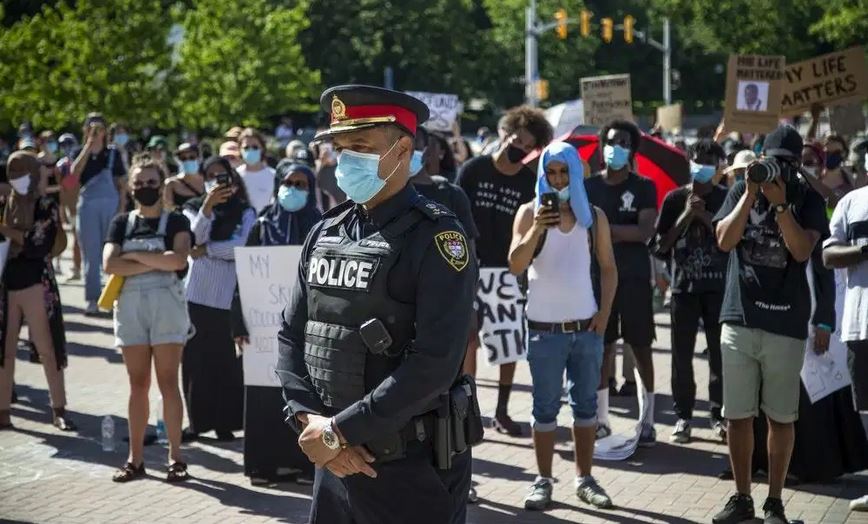
He continued setting himself apart from his predecessors by what he did during the June 20 march. Hundreds of us marched from the police station to City Hall to protest police violence, proclaim that all Black lives matter and remember Abdirahman Abdi who died after being pursued and beaten by Ottawa police in August 2016. Like the June 5 march, it was remarkable by the complete absence of police. I didn’t see a single officer from the time we started marching until the end of the demo – with one exception. When the march reached City Hall, and the temperature reached near forty degrees Celsius, one of the main organizers took to the stage, passionately talked about Abdi and stated the group’s demands. Standing in front of him, was one lone police officer in full uniform, standing with his hands crossed…just listening. It was Chief Peter Sloly.

Sloly is a smart guy. You don’t become a partner and Security & Justice lead at Deloitte if you’re not. Before he did that, Sloly was on the Toronto Police force for 27 years, rising to Deputy Chief.  He has a Bachelor of Arts in Sociology and Masters of Business Administration.

He also clearly understands the power of symbolism and the need to back it with real action.

Give that guy a raise.