Categories
OPSB

The Ottawa Police Services Board doesn’t want to hear public delegates – and doesn’t care what people say when they do

I just spoke at the Ottawa Police Services Board, as I do almost every month. Below is what I said…

“Well, here we are at the first meeting being held under the draconian and authoritarian new rules you all voted to implement at your last meeting. But, before I continue, let me define what draconian and authoritarian mean because I suspect some of you don’t know. Draconian means “excessively harsh and severe” and authoritarian means, “favoring or enforcing strict obedience to authority at the expense of personal freedom.” Let me also state for the record what changes you made to public delegations. You limited delegations to only one hour when there was never a limit on the total # of delegations before. You kept delegations to 5 minutes but, under your new rules, if more than 12 people sign up for the hour time slot, each delegate will be cut to 3 minutes. You said you are giving priority to people who haven’t spoken in the last 3 months, which appears to directly target myself and other activists who make the effort to speak regularly. And, finally, you now require people to submit their remarks in writing beforehand. And, although even your own motion doesn’t say we have to provide our written remarks word-for-word, Chair Valiquet is forcing us to even though that’s not what you voted for.

Now, you said you wanted our written remarks beforehand so you could better prepare to engage with delegates and, seeing as I complied and sent you my remarks 3 weeks ago, and because I suspect that I am one of a few, if not the only, delegate today because of these new rules, I certainly won’t waste the Board’s valuable time reading my remarks now but will, instead, spend the rest of my time taking your questions.”

Not one Board member asked a question. What follows are the full written remarks I sent the Board March 3:

“You said you made these changes so the Board can have time to do its important work of ensuring Ottawa has adequate and effective police services. So seeing as you just gave the OPS a $15 million raise I will spend the rest of my time talking about how effective – or not – the OPS is.

The OPS is very effective at its own propaganda. We saw an example of that last month when, during Black History Month, Chief Stubbs attended a service at Parkdale United Church where George Floyd’s brother Terrence spoke. And I gotta hand it to you, that was a brilliant PR move. A photo op with George Floyd’s brother, with former police chief Peter Sloly on one side and Ottawa community activist Gwen Madida on the other. Too bad it got zero attention. What also got little attention was what happened to Gwen a few days later. A few days later Gwen posted a picture of her bloodied face saying she and a young Black man she was with had just been assaulted by a white man who called them the N-word repeatedly while he was doing it.

And the whole thing was caught on video…Gwen called the police…so was their response an example of effective policing? Did they charge the man with a hate crime like they rightly charged the students who committed the act of antisemitism at an Ottawa high school last fall? We still don’t know and this really makes us question how effective the OPS hate crime unit is.

So we question how effective the OPS is at stopping people from hurting Black people…and we also question how effective the OPS is at stopping young Black men from hurting and killing each other. We know the OPS has a Guns and Gangs unit that had 22 officers as of last year. So, how many guns did the Guns and Gangs unit seize last year…especially those from the US? We ask because in July last year media reports said that of all the handguns involved in crimes in Canada that were traced in 2021, 85% came from the U.S.

We tried to find out more about this but couldn’t find anything on the OPS website giving any detail at all about the success – or lack thereof – of the Guns and Gangs unit. And there’s no point filing a Freedom of Information request because the OPS has denied every one we’ve submitted.

Why would the OPS make it so hard to find out how effective they’re being at reducing the numbers of illegal guns in neighborhoods where lots of young Black men live? 

But let’s change focus and look at how effective the OPS is at addressing one of the main issues identified by the majority of Ottawa residents: traffic. The OPS budget you approved last month says that, in multiple public surveys, Ottawa residents identified road safety as a top concern and that it remains a number one priority for the OPS. However, during the March 1 budget meeting, Councillor Sean Devine said he had spoken to Deputy Chief Bell about his constituents’ concerns about traffic and that the Deputy Chief had told him policing is not the answer to speeding and road safety. Really? Even with a budget of more than $400 million dollars that includes 37 officers in the Traffic Services Unit? Do you really think that is effective?

Perhaps the OPS will spend some of their $15 million increase on some expensive traffic tech saying that it will increase their effectiveness. Because that’s what they tell us about tech like body cameras. The OPS says body cameras will reduce police violence. But, in June 2020, Ottawa Police Service Board acting chair Sandy Smallwood asked Chief Sloly his opinion on body cameras and the Chief said research was mixed at best on how useful the cameras are at decreasing use of force by officers. He also said that the financial impact of the pandemic on the police force would mean trade-offs would need to be made between investments in body cameras and other OPS and board priorities. Chief Stubbs acknowledged the conflicting body camera research at the Board’s February meeting – then you and Ottawa City Council approved the budget that includes a body camera pilot project – and everything else the OPS asked for. No trade offs needed. Our view is that, rather than helping to make the OPS more effective, body cameras will just lead to more trauma porn.

So, despite all the evidence of the OPS’ ineffectiveness, you gave them a $15 million dollar raise. And you did that even after Justice Rouleau released his report on the Ottawa trucker occupation that countered the leaked OPS narrative that the OPS failure was all former Chief Sloly’s fault. The report says, “Much of the focus of the evidence was on Chief Sloly. It is all too easy to attribute all of the deficiencies in the police response solely to him but this would be unfortunate and indeed, inconsistent with the evidence. As well, some errors on Chief Sloly’s part were unduly enlarged by others to a degree that suggests scapegoating.” 

So if Chief Sloly wasn’t solely responsible, who else was? We don’t know because you haven’t done your job and asked those questions. You just gave millions more to the OPS despite the fact that the OPS’s own data shows they spend less than 1% of their time responding to Priority 1 calls where there’s imminent threat of bodily harm.  Meaning, armed OPS officers spend 99% of their time doing things like directing traffic, babysitting construction sites and responding to mental health calls. They also spend much of their time over-policing marginalized people including moving unhoused people away from businesses and using force disproportionately on Black, Middle Eastern and Indigenous people.

So because you’re not fulfilling your mandate to ensure effective policing in Ottawa and you’re limiting public input that would help you do your job properly we’re filing a complaint against the Board with the Ontario Human Rights Tribunal.

It’s time to continue reimagining community safety in Ottawa by finally giving up on the myth of reforming the OPS and freezing the OPS budget pending the outcome of the line-by-line audit of all city services, including the OPS.”
Categories
EDI

Jordan Peterson wants us to shut up about D.I.E., deliver his Amazon packages and DIE

I attended former University of Toronto psychology professor Jordan Peterson’s January 30 talk at the Canadian Tire Centre with what appeared to be about 5000 white people. Peterson has risen to fame doing things like calling “Equity, Diversity and Inclusion”, “Diversity, Inclusion and Equity” or DIE. And he hates DIE. I mean he really hates it.

In a January 2022 National Post article Peterson said, “Diversity, Inclusivity and Equity — that radical leftist Trinity — is destroying us. Wondering about the divisiveness that is currently besetting us? Look no farther than DIE. Wondering — more specifically — about the attractiveness of Trump? Look no farther than DIE. When does the left go too far? When they worship at the altar of DIE, and insist that the rest of us, who mostly want to be left alone, do so as well. Enough already. Enough. Enough.”

Peterson believes the current system has some flaws but essentially works on “meritorious selection”. He implies that white people, especially white men, dominate so many places because they have pulled up their boot straps and risen to that level on their own merit. He says things like employment equity (or affirmative action in the US) are misguided and lead to unqualified members of equity seeking groups getting hired because, “there simply is not enough qualified BIPOC people in the pipeline to meet diversity targets quickly enough (BIPOC: black, indigenous and people of colour, for those of you not in the knowing woke).” 

Peterson’s claim that there aren’t enough qualified brown folks demonstrates his poor understanding of Canada’s federal Employment Equity Act. The Act does set EE group hiring targets for federally regulated organizations but those targets are based on the percentage of qualified members of those groups available in the workforce, known as workforce availability. 

So if, for example, a department is looking to hire engineers, and 7 percent of qualified engineers available in the workforce are women, they must try to achieve 7 percent female engineers in their organization. So saying there aren’t enough qualified people to meet the target makes no sense when the target directs organizations to choose only from pools of qualified candidates.

Peterson’s hate of EDI is rooted in two central beliefs: that society should prioritize individual – not group – rights and responsibilities, and that society should be based on equality of opportunity not equality of outcome.

The first belief focuses on “groups” like LGBTQ+ folks or women, asking for rights and Peterson opposing that with really logical sounding (at first) quotes like, “Groups can’t have rights because no group can be held responsible.” So what about things like the Persons case that gave women the right to be legally recognized as persons? Or what about when slavery was abolished and gave Black people the right not to be owned? In both cases it was individual women or Black people who were granted rights because of being part of a group – a critical nuance Peterson misses. 

But what about group responsibility? Peterson is right about not being able to hold groups responsible, but that’s not the point – it’s the individuals who are held responsible. Again, in the case of Black people and employment equity, individuals are held responsible for things like being honest about their qualifications and meeting their job requirements. If they don’t, they get fired (you can’t fire a group).

Peterson’s “equality of outcome” point is partly based on his misunderstanding of workforce availability and the evidence members of equity groups give to demonstrate the existence of systemic discrimination. 

Peterson says organizations like universities are forced to provide equality of outcome by being required to have the same percentage of each equity group at every staff level as the percentage of that equity group in the population. And he says that if the organizations fail to meet that target, equity groups accuse them of systemic discrimination and that’s too simplistic a way to claim systemic discrimination.

First, as explained before, Employment Equity Act hiring targets are based on workforce availability of qualified candidates, not the percentage of that group in the general population. Second, most equity groups’ claims of systemic discrimination are based on decades of empirical data that they had to fight to get collected – not assumptions.

Peterson sees Western society as having some flaws but being the merit based best system in the world that has improved the lives of millions of people. He ignores the fact that two of the “flaws” – slavery and Indigenous genocide – are the foundation of the West’s wealth. He also ignores the glaring evidence of current systemic inequity: all the brown people working in low paying, gig economy jobs at places like Walmart, Amazon and Uber.

Peterson and his followers reflect a disturbing trend. They enjoy lifestyles in a system that causes and/or aggravates problems that disproportionately affect marginalized folks, like climate change or all the systemic issues that led to COVID disproportionately killing racialized people. However, they aggressively resist collective solutions to these problems – especially those led by government – as violations of their freedom. The Ottawa “Freedom Convoy” occupation was an example of this.

Peterson and his supporters just want to be left alone – with occasional interruptions from all the brown, mostly immigrant people – who clean their hotel rooms and deliver their Amazon packages and Uber Eats. And they don’t want to talk at all about their role in contributing to the systemic discrimination that severely limits the choices – and therefore the freedom – of so many racialized people, corralling them into those low paying jobs – and keeping them there.

Categories
EDI Police reform

It’s time to give up on the myth of police reform

On February 23, we got more concrete evidence that trying to reform the police doesn’t work – and never will. Researchers with the Tracking Injustice project released their preliminary data on police-involved killings in Canada revealing there have been more than 700 police use-of-force deaths in Canada since the year 2000. And Black and Indigenous people accounted for 27% of those deaths, although a lack of race statistics means the real percentage could be much higher. So, despite the increased budgets for more training, hiring more officers – especially diverse ones – and expanding community policing, the cops keep killing people, especially Black and Indigenous people.

Police and their supporters keep telling us that the police need to be reformed, not abolished. They say we must be patient because “these things take time” but change will come. Yet, the evidence tells another story.

In May 2022, the Ottawa Police Service released its use-of-force race data showing they use force disproportionately on Black, Middle Eastern and Indigenous people. OPS Deputy Chief Bell presented the use-of-force race data as if they had collected it voluntarily. They didn’t. The Ontario government ordered them to collect it over two years ago just like the Ontario Human Rights Commission ordered them to collect race-based traffic stop data back in 2013. And nine years later the result is the same: the OPS treats Black, Indigenous and Middle Eastern people worse. Nine years of reform – more training, hiring more diverse officers, and expanding community policing – has done little to stop the police from disproportionately harming brown marginalized people.

Last year provided some of the strongest evidence of why the Ottawa Police Service in particular is beyond reform. 

2022 started with the “Freedom Convoy” occupation in Ottawa where the Ottawa police stood around doing nothing for the first three weeks. Then came the resignation of Ottawa’s first Black police chief, Peter Sloly, accompanied by media stories quoting “unnamed” OPS sources using the standard – and very racist – angry Black man narrative accusing Sloly of bullying and volatile behaviour that compromised the force’s ability to cope with the truck protest. Sloly had faced racist resistance from day one after he began making changes to address systemic racism and sexism among other issues. The Ottawa Police Services Board hired Sloy’s replacement, Eric Stubbs, three days before Ottawa’s election, despite calls to postpone the hiring until after the vote. And the Board didn’t just hire any guy to replace Sloly. They hired the guy who led the BC RCMP’s operation to violently remove Wet’suwet’en people protesting a pipeline being built on their land.

So, before diversity at the very top could fundamentally change the Ottawa Police Service – the OPS got rid of the diversity. Yet, the new chief keeps saying diversity and inclusion is one of the OPS’ priorities and that they plan to ensure plenty of diversity among the 25 new officers they plan to hire. But having a more diverse workforce didn’t stop five Black Memphis police officers from beating Tyre Nichols to death in January of this year. The OPS issued a statement condemning those officers supposedly because OPS officers would never be caught on video viciously beating a Black man who later died…well, except for Abdirahman Abdi.

More diverse officers don’t change policing – policing changes them. It changes them even if they work with units with nice, euphemistic names like SCORPION, the Street Crime Operation to Restore Peace in Our Neighborhood – or Neighborhood Resource Teams, like the OPS calls its latest “community policing” initiative. It changes them. And we will soon have data that will likely back this up… 

In November, 2022, the Ontario Human Rights Commission welcomed changes Ontario’s Solicitor General had made to police use-of-force reporting form including allowing it to “capture important contextual information about use of force incidents, such a…demographic details about the officer who submitted the report, such as their age, race, and gender identity.” (They also added the capability to collect factors that informed the reporting officer’s perception of the subject’s race, the subject’s perceived age and gender identity, de-escalation options used by the officer and the level of physical control used.) The problem is the word “allow”. If officers aren’t mandated to include their race, they likely won’t.

Another popular reform that people argue will reduce police violence are body cameras – especially after the May 2020 murder of George Floyd. In June 2020, Ottawa Police Service Board acting chair Sandy Smallwood, told former Ottawa police chief Peter Sloly that the Board had received several emails from members of the public demanding body-worn cameras for police officers and asked Sloly his opinion on them. In a July 2020 Ottawa Citizen article Sloly said research was “mixed at best” on how useful the cameras are at decreasing use of force by officers and that the financial impact of the pandemic on the police force would mean trade-offs would need to be made between any investments in (body-worn cameras) and other OPS and board priorities currently underway. 

Ottawa’s new police chief, Eric Stubbs, acknowledged the conflicting body camera research at the Ottawa Police Services Board’s February 2023 meeting – then the Board and Ottawa City Council approved the budget that includes a body camera pilot project – and everything else the OPS asked for. No trade-offs needed.

Despite the overwhelming evidence that reforms don’t work, some Black folks, including some very high profile ones, continue to advocate for reform.

In February, during Black History Month, George Floyd’s brother Terrence visited Ottawa and spoke at two events. In an interview on the popular Breakfast Club podcast he explained why his Brooklyn, New York-based We Are Floyd Foundation partners with the New York Police Department, “I want to change the narrative….I want to bring the narrative back from my era where you had the police playing basketball with us…you had them understanding our culture and our community…I mean you had the bad apples but the majority…we saw them interact with us.”

There are several problems with brother Floyd’s position. The first is that the narrative he wants to change “back” to is the one the police have been pushing for years – and still are. That is the idea that the problem is only because of “a few bad apples” and that the solution is increasing “community policing”. However, despite increasing police budgets being used to hire more diverse officers (i.e. good apples) and expanded community policing, the police continue to shoot and kill unarmed Black people – including 61 people – and counting – since George Floyd’s murder.

A student who heard Terrence Floyd speak in Ottawa was quoted saying that, “hearing from Black leaders in the community and from Floyd is motivation to continue conversations around equity, diversity and inclusion. Change doesn’t take place overnight, but seeing how the eyes are open towards the issue is beautiful.” This idea that talking is the way to end systemic oppression and that those talks take time to have impact, is core to the idea of reform. And that’s because reform is a way to give the appearance of change without actually making any fundamental change.

That’s what’s led to the explosion of the diversity and inclusion illusion: performative change that looks good – but doesn’t actually change anything.

And the ironic thing is that there is such a huge push back against equity, diversity and inclusion (EDI) initiatives despite so much of it being performative. Popular anti EDI commentator, Jordan Peterson, got so popular attacking EDI that he left his job as a tenured psychology professor at the University of Toronto to write books and make YouTube videos and do stadium tours promoting his content.

Police love reform because it means more money. More money to hire more diverse officers. More money for training. More money for body cameras and…more money for performative EDI that changes nothing. 

It’s time to give up on the myth of police reform and continue defunding the police and reimagining community safety.

Note: After I posted and shared this post, a fellow abolitionist shared a great article by Critical Resistance distinguishing between reformist reforms which continue or expand the reach of policing, and abolitionist steps that work to chip away and reduce its overall impact. Some of the abolitionist steps include suspending the use of paid administrative leave for cops under investigation, prioritizing spending on community health, education and affordable housing and decreasing the size of the police force.

Categories
613-819 Black Hub Year in review

2022 – Another busy year for the Hub!

2022 was another busy year that saw the Hub work on issues related to education, health, business, municipal politics, addressing anti-Black racism nationally, climate change, Black federal public servants, police/criminal justice and more! 

Education – As a member of the Ottawa Carleton District School Board’s Valuing Voices Technical Advisory Group, the Hub continued to help the Board develop the best ways to share the identity-based data it collected in 2019. The data covers suspensions, sense of belonging at school and Grade 10 credit accumulation among other things. The data is a key tool for advocating for change so it’s crucial to make it as accessible and easy to use as possible for the public. One of the focuses this year was to figure out the schedule for refreshing the data on a regular basis.

The Hub also presented at the May Board meeting where trustees unanimously defeated a motion to reinstate the School Resource Officer program. The Board had ended the SRO program in 2021 after it did a human rights-based evaluation that found the program had been harmful to Black, Indigenous and LGBTQ+ students.

A Hub representative was part of the Loran Scholarship assessment team. The $100,000 Loran Scholarship was founded in 1988 as the first national undergraduate award based on a mix of academic achievement, extracurricular activity and leadership potential. However, no one the Hub spoke with had heard about it and we noticed there weren’t many Black faces among the pictures of past Loran scholars. Being part of the assessment team, which we will continue doing, allows us to help get more Black students to possibly get scholarships.

Health – The Hub was a member of the Ottawa Local Immigration Partnership’s Health and Wellbeing Sector Table. The group met regularly during the COVID-19 pandemic to share data on Black communities aimed at overcoming barriers to getting more Black folks vaccinated.

We also presented our Non-Police Mental Health Crisis Response for the City of Ottawa report to the Guiding Council on Mental Health and Addictions. The Ottawa Police Service created the Guiding Council in January 2021. It was moved under the City after public outcry about the police leading the initiative. The Council’s stated mandate is “to establish a strategy to support an enhanced or new Mental Health and Addiction crisis response system that will improve the outcomes for those experiencing crises related to mental health and substance use in the City of Ottawa.” However, its terms of reference say it’s working towards a system that will still include police “when the crisis is linked to criminal activity…”. 

People called for a different system partly because of the police-involved deaths of Abdirahman Abdi and Greg Ritchie. People called the police on Abdi because he was allegedly touching women in a coffee shop and on Greg Ritchie, an Indigenous man, because they said they saw a man with a knife – that turned out to be a ceremonial tomahawk. As touching women and carrying knives are both criminal activities, both men would likely end up just as dead under the “new” system the Guiding Council is working to create. The Council’s terms of reference say nothing about shifting money now spent on mental health response from the OPS to other organizations once the OPS stops doing it. The Hub presented our detailed plan for a system that involves no police and will shift money saved to social services that address the root causes of criminal activity.

We also attended the excellent Mental Health of Black Communities conference hosted by the Interdisciplinary Centre for Black Health and the Vulnerability, Trauma, Resilience & Culture Research Laboratory (V-TRaC), led by Dr. Jude Mary Cénat.

Business – Ever since cannabis was legalized the Hub has been saying Black folks should get into the business that’s now dominated by white men. With this in mind, the Hub attended Health Canada’s 2022 Cannabis Licensing – Diversity, Equity and Inclusion Forum focussed on diversifying the industry. Afterwards, we connected with Michael and Ashley Athill, brother/sister owners/founders of HRVSTR Cannabis. We spoke about how the Hub could find a place in the industry with our skill set. Right now we’re working on a business model that would have us work to help people clear their criminal pot records and get into the business. They would then give the Hub a cut of their profits.

The Hub also attended the launch of, and a two-day conference on, the Black Entrepreneurship Knowledge Hub to learn about the latest data on Black business – and connect with some of the key folks producing it.

Municipal politics – The Hub participated in Ottawa’s Oct. 24 election by attending debates and asking candidates questions focused on Black community interests and helping organize a school trustee meet and greet. We created a document with information on candidates’ position on key issues of concern to Black Ottawa residents, canvassed door-to-door and had a rep as a panelist on Rogers TV Ottawa’s election night panel. 

Federal government – The Hub led the push for the Government of Canada to appoint a Black Equity Commissioner similar to the permanent Special Envoy on antisemitism and new Special Representative on Islamophobia it announced in its 2022 Budget. Beyond the obvious reason of simple equity, there are other reasons for appointing a Black Equity Commissioner. Firstly, with a little under two years left in the U.N. Decade for People of African Descent, which runs from 2015-2024, the Commissioner will help ensure addressing anti-Black racism remains a federal focus after the Decade ends. Secondly, with Statistics Canada reporting that Black Canadians faced the most hate crimes in Canada in 2020 and other data showing Black Canadians continue to be disproportionately negatively impacted by the COVID-19 pandemic, lack of affordable housing, under-employment and other social determinants of health the Commissioner is more essential than any moment in recent history to safeguard and expand substantive equality rights for Black people. In December, the Hub called for the Black Equity Commissioner at the Black Parliamentary Caucus pre-budget consultation in Ottawa, got an opinion piece published in the Ottawa Citizen and reached out nationally to get support for the commissioner from Black groups.

Climate change – The Hub spoke in September at the Ottawa chapter of the global Climate Strike in Ottawa the theme of which was “Together for Climate Justice”. The Hub pointed out how the reports from the international Intergovernmental Panel on Climate Change, the IPCC, and mainstream press reports about climate change say climate change started with, and continues to be caused by, “human activity” and how “we” must all come together to fix it. These reports make it sound like all humans contributed equally to starting climate change and are all contributing equally to making it worse. In fact, the climate crisis has its origins in the actions of a select group of humans responsible for the genocide of Indigenous people, the enslavement of African people, colonialism and capitalism. That select group of humans forced millions of enslaved Africans to work – sometimes literally to death – on mono-culture plantations that destroyed the soil. That same group drove the Industrial Revolution that was literally launched, and fuelled, by the violently coerced labour of enslaved Africans and created capitalism which, in its global excesses, values profits above people and the planet and has led us to the climate crisis we have today. 

Policing/criminal justice – The Hub continued its efforts to push for City Council and the Ottawa Police Services Board to reimagine public safety in Ottawa. We issued a news release and did several media interviews about the resignation of former Ottawa police chief Peter Sloly in the midst of the “Freedom Convoy”. We questioned the racist, angry Black man narrative leaked by OPS sources accusing Sloly of bullying and volatile behaviour that compromised the force’s ability to cope with the truck protest. We also presented regularly at Ottawa Police Services Board meetings calling for them to move money from the police to social services that actually make us all safer like housing and mental health. Just like journalist Desmond Cole had taken over a Toronto Police Services Board meeting in 2017 to demand the Toronto Police delete the data they collected from carding Black Torontonians, we took over the November 30 Ottawa Police Services Board meeting and refused to leave until they answered questions related to accountability of the Ottawa Police Service. Shortly after, we attended the OPS’ 7th Annual Human Rights Learning Forum and asked questions related to the issues we raised when we took over the OPSB meeting. Finally, we filed several complaints against the OPSB and OPS leadership with the Ontario Civilian Police Commission and the Office of the Independent Police Review Director for actions that helped the police but harmed public safety.

International – The Hub provided input to the Canadian delegation attending the first meeting of the UN Permanent Forum on People of African Descent in Dec. 5-7 in Geneva. The Forum will be an advisory body to the UN Human Rights Council, in line with the program of activities for the implementation of the UN International Decade for People of African Descent, which runs from 2015 to 2024.

In addition to all this, we supported local initiatives including:

  • Attending the Oct. 7 candlelight vigil for Anthony Aust marking the 2nd anniversary of his death following an Ottawa police raid on his 12th floor apartment
  • Joining graduating Black students on their symbolic Walk of Excellence from Lisgar High School to the University of Ottawa
  • Attending the federal Black Class Action’s press conference with Amnesty International where they announced they were filing a complaint with the United Nations regarding the status of Blacks in Canada.
  • Attending the Brotherhood Coalition’s Let’s Talk Black Men’s Mental Health BBQ
  • Attending the 3rd National Black Canadians Summit in Halifax 
  • Having a Hub table at the 2nd HorizonFest community group gathering hosted by our partner group Horizon Ottawa.
  • Meeting with the heads of Queen’s University Black Studies program to discuss how Blackademics and Blacktivists can work together 
  • Attending the inauguration of Awad Ibrahim as the first Air Canada Chair on Anti-Racism
  • Working with the international Can’t Buy My Silence campaign against the misuse of non-disclosure agreements to hide human rights abuses
  • Being a member of the Children’s Aid Society of Ottawa’s Race and Faith Based Advisory Committee addressing the over representation of Black youth in care
  • Hub coordinator Robin Browne co-hosting rabble.ca’s monthly Off the Hill political panel
  • Supporting Jaku Konbit’s mentorship program by mentoring a Black youth and attending program meetings.
  • Speaking to university and high school social justice classes

It was a busy year and we look forward to continuing the work in 2023!

Categories
Human rights World Cup

Profit trumps human rights at Qatar World Cup

Like millions of others I have been glued to my TV watching my country play in the Fifa World Cup in Qatar. However, watching the World Cup has felt similar to when I watched Game of Thrones and The Walking Dead: I have enjoyed it while also being struck by the huge problems with the whole thing.

Fifa awarding the World Cup to Qatar raised the question: how bad does a country’s human rights record have to be to disqualify it from hosting? 

Qatar is a non-democratic, country that has been ruled by the House of Thani family monarchy since Mohammed bin Thani signed a treaty with the British in 1868. In early 2017, Qatar’s total population was 2.6 million, with 313,000 of them Qatari citizens and 2.3 million expatriates. Eighty-eight per cent of the population are foreign workers, mostly South Asians, with those from India alone estimated to be around 700,000. Egyptians and Filipinos are the largest non-South Asian migrant group. The treatment of these foreign workers has been heavily criticized with conditions suggested to be modern slavery

This isn’t the first time Fifa, the global football governing body founded in 1904, has awarded the World Cup to a country with a horrible historical and ongoing record of human rights violations. The 1934 World Cup was held in Italy during the reign of fascist dictator Benito Mussolini, an ally of Hitler. The 1978 World Cup was in Argentina when military officer and dictator Jorge Rafael Videla was president. Wikipedia describes Videla’s reign as “among the most infamous in Latin America during the Cold War, due to its high level of human rights abuses and severe economic mismanagement”. And the 2018 World Cup was in Russia when Vladimir Putin was in power – and had invaded Crimea in 2014.

And just as we can ask how bad a country’s human rights record has to be to be disqualified from hosting the World Cup, we can also ask: how bad does it have to be for countries to boycott the event? 

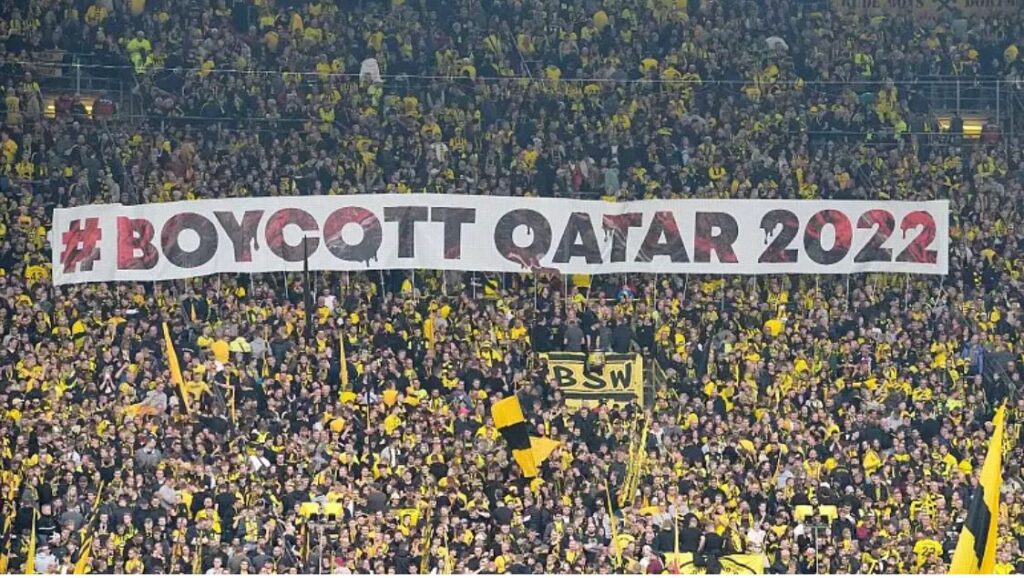
Clearly, no country found Qatar’s human rights record bad enough to boycott the World Cup. Norway and Germany’s governing football bodies considered boycotts that they decided against in the end. (Norway’s decision was made easier by Norway failing to qualify for the tournament.) In Germany, this was despite a strong boycott movement that saw fans hoisting huge #Boycott Qatar 2022 banners at German Bundesliga matches.

German fans hoist banner at German Bundesliga game in October 2022

Qatar hosting the World Cup also raises other questions, including: are some human rights more valued than others and do human rights vary country to country? The answer to both questions seems to be a clear yes.

Homosexuality is punishable by death in Qatar (so they probably won’t be hosting the women’s World Cup anytime soon given openly gay superstars like Canada’s Christine Sinclair and American Megan Rapinoe). And Fifa didn’t just tacitly support Qatar’s state-sanctioned homophobia by awarding Qatar the World Cup. It also threatened seven teams whose captains vowed to wear OneLove arm bands with sanctions if they did. The OneLove armbands were originally launched in 2020 as part of an inclusiveness campaign by the Royal Dutch Football Association (KNVB). Reuters reported that the KNVB campaign opposes discrimination on the basis of race, skin colour, sexual orientation, culture, faith, nationality, gender, age and “all other forms of discrimination”. Captains from England, Wales, Belgium, the Netherlands, Switzerland, Germany and Denmark were planning on wearing the armbands to protest Qatar’s laws against same-sex relationships. Fifa threatened to issue yellow cards to any player wearing the armband which could have led to them missing games. All seven teams abandoned their plans.

Some may wonder if Fifa is putting profits above people and considering Fifa recently said it has made $7.5 billion from World Cup commercial deals over the last four years, that appears to be the case. But it’s not only Fifa that put their morals on hold. The sponsors behind those commercial deals – including Adidas, Coca-Cola, Hyundai-Kia, Visa, Anheuser-Busch InBev and McDonalds – have all also apparently chosen profits over people. This is despite companies like Coke issuing statements like Coke’s 2019 How Coca Cola Supports Inclusion and Equality for the LGBTQ+ Community.

The thousands of fans attending in person also decided it’s OK to turn a blind eye to Qatar’s human rights policies and pump millions into the already rich Qatari economy. Will they also continue buying sponsors’ products with this massive stain on those companies’ claims of LGBTQ+ support? And, if they do, what incentive will those companies have to change their behaviour? Clearly, very little…

Another issue is that, although the Qatar World Cup has exposed how capitalism values profit over people, almost every World Cup exposed how unequally those profits are distributed. 

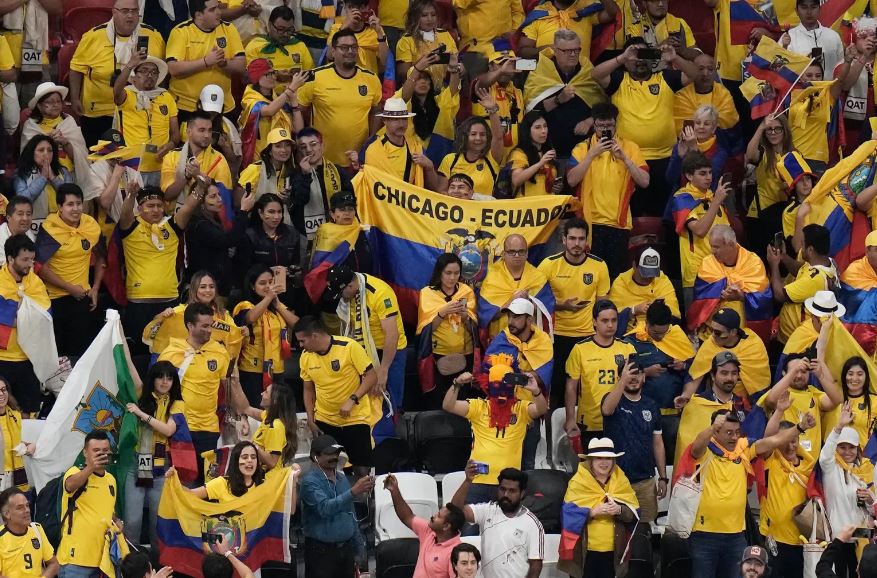
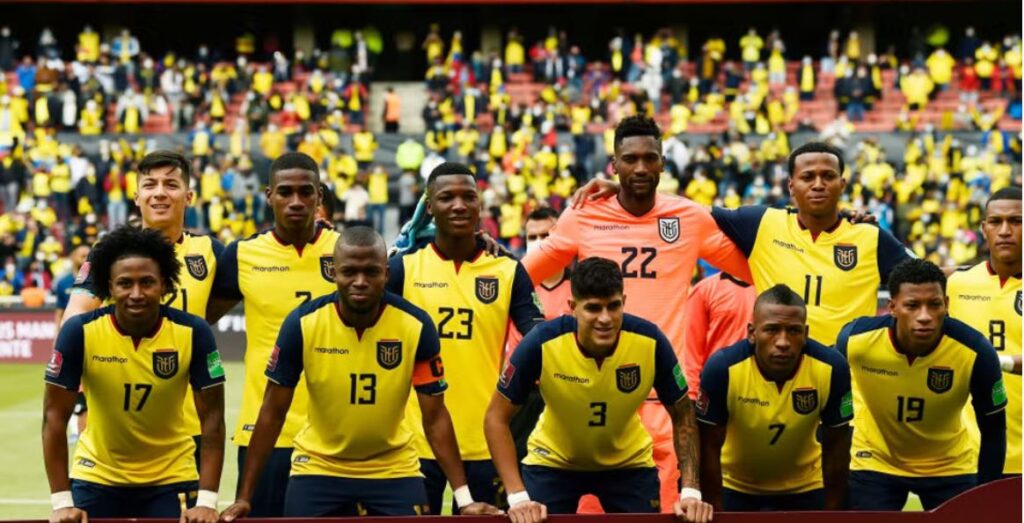
Watching the World Cup one is struck by how many Black faces there are on the field vs Black faces in the stands. This is particularly striking for countries like France, Ecuador and  especially Brazil – where over half the population is Afro-Brazilian – but there’s barely a Black face to be seen among the country’s World Cup fans. Attending any World Cup is expensive so the colors of a country’ fans give some indication who has the money in those countries.

Ecuador World Cup team
Ecuador World Cup fans

Fifa’s actions aren’t that surprising as, since Fifa awarded Qatar the World Cup in 2010, more than half of the 22 members of the FIFA Executive Committee which voted for Qatar have either been implicated in or investigated for alleged corruption or other bad practices, according to DW.com.

It would be great if football fans used their collective power to demand that Fifa do things like adopting the principle that if it wouldn’t award the women’s World Cup to a country because of human rights issues, it shouldn’t award that country the men’s World Cup either. 

North American activists will no doubt ensure that the human rights records of Canada, the U.S. and Mexico will be highlighted in the run up to the 2026 World Cup – and well they should, because clearly Fifa won’t.

Categories
Blackademics Blacktivists Mental health Police

Mental health Blackademics add to Blacktivist toolkit

My post How Blackademics and Blacktivists can support each other said producing research Blacktivists can use for advocacy is one of the main ways Blackademics can help Blacktivists. Another way Blackademics can help is by holding conferences to share that research.

Last week I attended a conference on the theme of Mental Health of Black Communities: Overcoming Obstacles, Bridging the Gaps where mental health Blackademics, mostly from North America, shared their research.

The lead organizer of the conference was Dr. Jude Mary Cénat, an Associate Professor in the University of Ottawa’s School of Psychology and Chair of the Interdisciplinary Centre for Black Health. Cénat is Director of the Vulnerability, Trauma, Resilience & Culture (V-TRaC) Research Laboratory, and holds the Research Chair on Black Health at the University of Ottawa. 

There were sessions on the problems with “color blind” approaches to mental health, the social determinants and racial issues affecting Black folks’ mental health, anti-Black racism in the child welfare system and lots more. (For more sessions, see the full conference program.) 

As a full time Blacktivist, my goal in attending the conference was to get direction on where to most effectively advocate to help improve Black folks’ mental health across Canada – and it didn’t take long to get what I came for! In his opening Wednesday keynote address, Achieving Black Mental Health Equity, Dr. Kwame McKenzie called for the creation of a federal Black Equity Act that would make Black equity a federally legal requirement. The call for such an act supports Blacktivists’ existing demand for the federal government to appoint a Black Equity Commissioner similar to the ones it announced for antisemitism and Islamophobia in the 2022 federal Budget. 

On Day 2, in her session Promoting Health Equity: Mental Health of Black Canadians. Mobilizing, Partnerships: Taking Steps Together for Supported Reintegration, Dr. Barbara-Ann Hamilton-Hench said Black communities need to challenge the federal Tri-Council to remove barriers to funding high quality research about and by Black people, and to fund Black researchers. The Canadian Institutes of Health Research (CIHR), the Natural Sciences and Engineering Research Council (NSERC), and the Social Sciences and Humanities Research Council (SSHRC) make up the Tri-Council funding agencies. They are the primary mechanism through which the Government of Canada supports research and training at post-secondary institutions and are supposed to support and promote high-quality research in a wide variety of disciplines and areas. This supports the work the 613-819 Black Hub had already begun regarding SSHRC. 

In 2021, we discovered the Ottawa Police Service attempting to continue to try to deploy more cops in the community under the guise of the Neighborhood Resource Team program, which is their latest name for “community policing”. The OPS NRT program had ballooned from $2.5 million and 18 officers in 2019 to over $11 million and 89 officers in 2021. And the OPS was leading an evaluation of the program that was pretty much guaranteed to conclude that the program was great and should be further expanded. The project started in fall 2019 when the OPS hired Carleton professor Linda Duxbury to lead it. After we found out about the project, we met with Duxbury and asked her why no Black groups were included in the project description for her project on the SSHRC website (SSHRC gave her almost $200,000 for the project). She said she had included Indigenous groups. As Duxbury had done a very flawed study of the Peel Regional Police’s School Resource Officer program, we brought that to the attention of the Ottawa police, who said the report was one of the reasons they hired Duxbury. We then filed a complaint with Carleton University’s Research Ethics Board who found no issues with Duxbury. Finally, we filed a complaint with SSHRC who also backed Duxbury. However, after we continued to press Duxbury to do proper research by including the voices of Black and Indigenous people in her NRT report, she and the OPS, instead, canceled the 3-year, $260,000 project. We then took a look at SSHRC’s website and found it appeared to have no research on defunding or abolishing the police but several problematic studies related to police reform. Professor Hamilton-Hinch’s call has reinforced our commitment to challenging SSHRC on these issues.

One problem frequently raised at the conference, but for which few solutions were offered, was the lack of Black mental health professionals. (There was a session called Innovative Training Programmes for Mental Health Professionals on Issues Related to Cultural Safety and Addressing Experiences of Racism, by Ribbon Rouge Foundation Programs Director Dr. Selina Kunadu-Yiadom which may have covered this but I didn’t attend it.) In one session, they did show a CBC article titled Black psychologists say there are too few of them in Canada — and that’s a problem featuring photos of Ottawa-based psychotherapists Helen Ofosu and Kafui Sawyer. However, they didn’t share the main point of the article which was Black mental health care professionals highlighting problems in the accreditation process for psychological professionals as a key barrier to getting more Black ones. The article cited how, to become an accredited psychologist in Canada, students need to be accepted into a graduate program at a post-secondary institution or an internship program. Getting into a program depends on having a faculty member agree to be their supervisor but Ottawa-based psychotherapist Kafui Sawyer pointed out that the faculties are predominantly white and the students they’re recruiting or the students they have in [their] program are also predominantly white. Ofosu and Sawyer have formed a Black psychology section of the Canadian Psychology Association, which will advocate for more diversity in the profession.

Another area where Black students may be facing systemic barriers is getting scholarships. I recently acted as an assessor for the Loran Scholarship. The $100,000 award has existed since 1988 but no one I recently asked had heard of it. I only found out about it last year when our son applied for it – and didn’t make it past the first step, so wasn’t interviewed. One of Loran’s managers asked me to be an assessor to diversify their assessor pool and the training session I participated in showed why. Out of about 60 people, I was the only Black man (there were two Black women) and there was no one who identified as Indigenous. In the question period, I asked what percentage of assessors were Black or Indigenous men. The Loran exec leading the session said she didn’t know but would get me the info. I assessed 37 applications, none of which identified as Black or Indigenous men. The Loran application doesn’t have a self-identification option so you must infer who’s Black or Indigenous from what they write. We need to share info about such scholarships to get more Black students to apply – and more Black assessors.

But Black students will only encounter scholarship or accreditation issues if – and it’s a big if – they manage to make it through a systemically anti-Black education system – and avoid being caught in the systemically anti-Black “justice” system.

On that note, two of the most glaring omissions at the conference were any mention of the impact of policing on Black mental health or the role – and responsibilities – of the Ontario government in addressing the issues raised.

Considering health is largely provincial jurisdiction, this omission was notable. As a full time activist, I came away with little direction on where to advocate, and what to advocate for, at the provincial level. The Ontario government recently created a new Black Equity Branch and hired a director so we plan to work with that person to identify and address the changes needed at the provincial level.

As for policing, the word “police” wasn’t mentioned once in the conference program and there was only one session focussed on justice, called Justice and Mental Health. The 90 minute breakout session had four presentations only two of which were actually about justice: one on restorative justice and one on criminalization of Black refugees. 

Having a conference on Black mental health without a strong focus on the impact of policing is like having a conference on Black physical health without a strong focus on poverty. Canadian police, including in Ottawa where I live and lead the 613-819 Black Hub, continue to kill, or be involved in the deaths of, Black people experiencing mental crises. People who aren’t in crisis – yet – continue to have their mental health negatively impacted by sometimes violent interactions with police. Young Black and Indigenous Ottawa activists are still dealing with the mental impact of the Ottawa police arresting them after they blocked an intersection in November 2020 to protest the acquittal of Ottawa police constable Daniel Montsion in the 2016 beating death of Abdirahman Abdi (the police charged 12 of the about 30 protesters – then “stayed” the charges for one year, which meant that if any of the young people caused any “trouble”, the charges could be immediately reinstated.)

Next conference it would be good to see some research on things like the impact of layered policing on Black mental health. In his March 2021 Spring Magazine article Layered policing’ expands police amid calls to defund, Jeff Shantz describes layered policing as, “In response to community calls to defund police and fund necessary social resources, cities across the country have instituted “layered policing.” From Lethbridge to Saskatoon to Kitchener-Waterloo, these moves would actually deploy more police throughout the community, and embed policing in everyday social life.”

In January 2021, in response to community calls for the police to get out of mental health crisis response, the Ottawa Police Service presented the Ottawa Police Services Board with its initiative to create an alternative mental health crisis response system. The OPS said they had brought together a group of partner organizations to lead the initiative called the Guiding Council. The only problem was, they hadn’t told some of the partner organizations, including the Ottawa Black Mental Health Coalition of which the 613-819 Black Hub was a member. 

After yet another public outcry at the OPS leading such an initiative, the OPS agreed to have it moved under the management of the City. However, instead of removing themselves from any leadership role in the initiative, as the public demanded, they did exactly the opposite and joined the Guiding Council which they weren’t on when they first created it. We later learned that the Guiding Council would, in consultation with the City, decide which community groups get $2 million dollars of the $3 million cut from the OPS’ requested $14 million dollar 2022 budget increase. 

The Guiding Council is yet another place where the OPS appears to be pushing for a mental health crisis response system that still has lots of police involvement and zero impact on their annual multi-million dollar budget increases. The OPS’ influence is already clear in the Guiding Council’s terms of reference which aims for a system that still sends cops, “when the crisis is linked to criminal activity”. Wouldn’t that include a situation like Abdirahman Abdi who people called the cops on because he was allegedly touching women in a coffee shop? And wouldn’t that still include a situation like Greg Ritchie, an Indigenous man who people called the cops on because they said they saw a man with a knife that turned out to be a ceremonial tomahawk? Yes it would. Abdi and Greg would likely end up just as dead under the system currently being proposed by the Guiding Council.

The OPS influence is also clear by the lack of any mention in the Guiding Council’s terms of reference of either the 613-819 Black Hub’s alternative non-police mental health crisis response report or Toronto’s non-police mental health crisis response teams it launched in March 2022. 

The recently released report, Troubling Encounters: Ottawa Residents’ Experience of Policing, confirmed that racialized and low income Ottawa residents have extremely low levels of trust in the Ottawa police. In fact, the report states, “In short, for many people in this city, police do not contribute to individual or community safety, in fact, they appear to do the very opposite.” Allowing the police to remain on the Guiding Council will further erode what little trust there is – and further erode Black Ottawa residents’ mental health.

For the next Black mental health conference Blackademics should engage Blacktivists in the early planning stages so the conference deals more fully with the impact of carceral systems like policing, courts and jails – and has concrete suggestions for where activists should focus their advocacy.

Categories
civil rights movement Jewish activism

Black and Jewish activists share a long history of collaboration

As today marks the start of the Jewish holiday Yom Kippur, the holiest day in Judaism, we reflect on decades of Black and Jewish social justice activists struggling, living – and dying – side by side in the cause of creating a more equitable world.

I started my activism fighting against South African apartheid and quickly leared about Jewish South African activist and politician, Joe Slovo. “A Marxist-Leninist, Slovo was a long-time leader and theorist in the South African Communist Party (SACP), a leading member of the African National Congress (ANC), and a commander of the ANC’s military wing Umkhonto we Sizwe (MK). A South African citizen from a Jewish-Lithuanian family, Slovo was a delegate to the multiracial Congress of the People of June 1955 which drew up the Freedom Charter. He was imprisoned for six months in 1960, and emerged as a leader of Umkhonto we Sizwe the following year. He lived in exile from 1963 to 1990, conducting operations against the apartheid régime from the United Kingdom, Angola, Mozambique, and Zambia. In 1990 he returned to South Africa, and took part in the negotiations that ended apartheid. After the elections of 1994, he became Minister for Housing in Nelson Mandela’s government.” (from Wikipedia). One of our strongest supporters in the fight against South African apartheid was the former Canadian Jewish Congress.

Elements of Jewish involvement in the U.S. civil rights movement, like the June 1964 murders of young, Jewish activist “freedom riders” Andrew Goodman and Michael Schwerner, and Rabbi Abraham Joshua Heschel marching with Martin Luther King in Selma, Alabama in March 1965, have been well publicized. However, what has gotten less far attention are things like, “…in the early 1900s, Jewish newspapers drew parallels between the Black movement out of the South and the Jews’ escape from Egypt, pointing out that both Blacks and Jews lived in ghettos, and calling anti-Black riots in the South “pogroms”. Stressing the similarities rather than the differences between the Jewish and Black experience in America, Jewish leaders emphasized the idea that both groups would benefit the more America moved toward a society of merit, free of religious, ethnic and racial restrictions.

A 1934 ore-miner strike leading to the killing of several Black miners was the catalyst for physicist Joseph Gelders‘ civil rights activism and labor organizing efforts. Gelders and his wife Esther started hosting a weekly discussion group for students at University of Alabama at Birmingham. He established an Alabama committee to work on the Scottsboro Boys case, [where nine African American teenagers and young men, ages 13 to 20, were accused in Alabama of raping two white women in 1931.] Due to his efforts, on September 23, 1936, Gelders was kidnapped and assaulted by members of the Ku Klux Klan

The American Jewish Committee, the American Jewish Congress, and the Anti-Defamation League were central to the campaign against racial prejudice. Jews made substantial financial contributions to many civil rights organizations, including the NAACP, the Urban League, the Congress of Racial Equality, and the Student Nonviolent Coordinating Committee. About 50 percent of the civil rights attorneys in the South during the 1960s were Jews, as were over 50 percent of the Whites who went to Mississippi in 1964 to challenge Jim Crow Laws.[5] Julius Rosenwald was a Jewish philanthropist who donated a large part of his fortune to supporting education of Blacks in the South by providing matching funds for construction of schools in rural areas.[14] Jews played a major role in the National Association for the Advancement of Colored People (NAACP) in its early decades. Jews involved in the NAACP included Joel Elias Spingarn (the first chairman), Arthur B. Spingarn, and founder Henry Moskowitz. More recently, Jack Greenberg was a leader in the organization. 

Cooperation between Jewish and African-American organizations peaked after World War II—sometimes called the “golden age” of the relationship. Leaders of each group joined each other in order to launch an effective movement for racial equality in the United States, and Jews funded and led some national civil rights organizations. Conversely, African-American Civil Rights leader W. E. B. Du Bois wrote testimonies and op-eds in Jewish publications that decried the Nazi violence in Europe after he visited the eviscerated Warsaw Ghetto. Historically, Black colleges and universities also hired Jewish refugee professors who were not given comparable jobs in white institutions because American culture was anti-semitic. This era of cooperation culminated in the passage of the Civil Rights Act of 1964, which outlawed racial or religious discrimination in schools and other public facilities, and the Voting Rights Act of 1965, which prohibited discriminatory voting practices and authorized the government to oversee and review state practices.

Northern and Western Jews often supported desegregation in their communities and schools, even at the risk of diluting the unity of their close-knit Jewish communities, which were frequently a critical component of Jewish life.

In 1965, Martin Luther King Jr., said,

How could there be anti-Semitism among Negroes when our Jewish friends have demonstrated their commitment to the principle of tolerance and brotherhood not only in the form of sizable contributions, but in many other tangible ways, and often at great personal sacrifice. Can we ever express our appreciation to the rabbis who chose to give moral witness with us in St. Augustine during our recent protest against segregation in that unhappy city? Need I remind anyone of the awful beating suffered by Rabbi Arthur Lelyveld of Cleveland when he joined the civil rights workers there in Hattiesburg, Mississippi? And who can ever forget the sacrifice of two Jewish lives, Andrew Goodman and Michael Schwerner, in the swamps of Mississippi? It would be impossible to record the contribution that the Jewish people have made toward the Negro’s struggle for freedom—it has been so great.” (all italics from Wikipedia)

In Canada, Jewish advocacy led to striking down inequitable laws that disproportionately impacted Jews and Blacks. In his 2000 address, Jews, Human Rights and the Making of a New Canada, former Canadian Jewish Congress president Irving Abella spoke about how advocacy by the Congress’ Joint Public Relations Committee (JPRC) led to the Ontario government passing the 1951 Act to Promote Fair Employment Practices in Ontario. He spoke about how, in Dresden, Ontario at that time, “…it was reported that 4 of the town’s 5 restaurants would not serve Blacks nor would the hotels allow Blacks as guests….Blacks were excluded socially and economically from town life; barbershops, beauty salons, taverns and pool halls refused admission and service to all Blacks.”

Abella detailed how, “after the Fair Employment Practices Act had passed, the human rights groups around the Congress’ JPRC began lobbying for a fair accommodations practices law. And Dresden became the focus for the struggle. So outrageous was the anti-Black behaviour of many of the town’s businesses, that a huge lobby led by the Jewish Labour Committee was mounted to compel the government to introduce legislation preventing discrimination in housing and service. And in March of 1954, the [Leslie] Frost government introduced just such a bill in the Ontario legislature.”

The close relationship between Black and Jewish activists during the Civil Rights era waned in subsequent years for various reasons. Despite that, there were notable Jewish activist exceptions who did great work that positively impacted Black Canadians. The progressive powerhouse Lewis family – father Stephen Lewis, son Avi Lewis and Avi’s wife, Naomi Klein, have been doing great social justice work for decades. From Stephen Lewis’ 1992 report on race relations in Ontario, to his work in Africa as the U.N. envoy on HIV/AIDS, to Naomi’s Klein’s work on “disaster capitalism” to Avi and Naomi’s work on climate change, the Lewis family has been at the forefront of highlighting issues affecting Black Canadians and other marginalized groups.  

The global Black Lives Matter protests following George Floyd’s murder and the pandemic have brought Black and Jewish activists together again, this time to address the rise in hate crimes against both groups.

Ottawa’s United for All is a multi-faith coalition of 44 organizations representing 150+ partners committed to overcoming hate-based violence, racism, and extremism in East Ontario. Before his death in 2021, former Canadian Jewish Congress President and Kind Canada founder Rabbi Reuven Bulka was one of United for All’s main proponents. 

Although Black and Jewish social justice activists have always had to contend with those who want to maintain the status quo – including members of their own communities – their collaboration has, and continues to, lead to change and a better world for all.

Categories
Blackademics Blacktivists

How Blackademics and Blacktivists can support each other

How can Blackademics and Blacktivists best support each other? One obvious way is for Blackademics to produce research Blacktivists can use for advocacy. El Jones, who is a full time Blackademic and Blacktivist, did this when she co-authored the report Defunding the Police: Defining the Way Forward for HRM. Carl James of York University has been producing research for decades that Blacktivists have used. James’ work covers intersectionality of race with ethnicity, gender, class and citizenship, accessibility and equity in education and employment and the complementary and contradictory nature of sports in the schooling and educational attainments of racialized students. 

Producing research on systemic racism in institutions outside academia is important but so is doing research that exposes it in academia. Kanika Samuels-Wortley of Toronto Metropolitan University (formerly Ryerson) did this with her paper exposing the gatekeeper system that blocks effective police research: Black On Blue, Will Not Do: Navigating Canada’s Evidence Based Policing Community as a Black Academic – A Personal Counter Story.  

While initiating research, or having some role in its initiation, is great, making sure important research initiated by other means is done right is also important. Lorne Foster was one of two York University human rights experts who collected and analyzed the Ottawa Police Service’s use-of-force race data after the Province of Ontario ordered all Ontario police forces to collect the data starting in January 2020. The data showed that the OPS used force disproportionately on Black, Middle Eastern and Indigenous people. 

Helping Blacktivists groups understand and use data is another way Blackademics can help. Disaggregated race data – that separates out the data on Black folks in particular – is both crucial to Blacktivism and very complicated to do right. That complexity gives those resisting equity a ready excuse not to collect data. Having Blackademics join data advisory groups with Blacktivists or advise Blacktivist reps on such groups helps groups turn data into tools for advocacy.

Hiring activist minded staff is another way the academy can support Blacktivists. Queens University launched a Minor in Black Studies program in spring 2022 and hired a promising group of Blackademics specializing in radical Black ecologies, Black health and social change, Black religions, Black creative writing and cultural production, Black political thought, and surveillance, anticolonial and gender studies. One of the program’s leads, Professor and Canada Research Chair in Black Studies Katherine McKittrick, says one of the new hires, Vanessa Thompson, is an abolitionist. McKittrick says, “Black Studies does not reside solely with the University. It’s also a field that’s inflected with protest, resistance and activism. The field and scholars are committed to non-academic forms of social change and often pair their research with practical on-the-ground struggles”. Another one of the program leads, Daniel McNeil, the Queens National Scholar Chair in Black Studies, says he went into Black Studies, “To hold our institutions accountable and to scrutinize how they do, or do not, live up to their rhetorical commitments to equity.” He says he was inspired by the work of people like Canadian Richard Iton who wrote In Search of the Black Fantastic: Politics and Popular Culture in the Post-Civil Rights Era. McNeil says, “What I took from this type of work is not that we should translate Black cultures for academics to make them a little bit less exotic or a little bit easier for mainstream consumption but how can we open up spaces in the academy for the knowledge of communities? How can we resist the idea that we’re here to help people outside the academy speak or tell them what to say? And how can we push and struggle and demand that we need to learn from their political and moral intelligence?”

This highlights an important issue. Blackademics, being middle class, have the same challenges as middle class Blacktivists: connecting with lower income Black folks to ensure their work is informed by those most impacted by systemic anti-Black racism. And they have the same challenge as all Blacktivists, inside or outside the academy – not losing their jobs by pushing for fundamental change.

Employees challenging systemic anti-Black racism at work usually meet anything from passive aggressive to very aggressive resistance. It’s risky business and must be done carefully, sometimes covertly. One way for Blackademics to do this is to anonymously tip off activists if they become aware of any of their colleagues doing problematic research. My group, the 613-819 Black Hub, had a case about a year ago where this would have been very helpful.

Purely by accident, we found out that the Ottawa Police Service had hired a local professor to evaluate the latest OPS community policing initiative called the Neighborhood Resource Team program. The professor had done some very flawed research on the school resource officer program (that has cops in schools) in another part of the province. Once we found out, we pushed the prof to do proper research but, instead of doing that, she and the OPS cancelled the entire three year, $260,000 project. If we hadn’t found out about the evaluation, the prof and the OPS would have proceeded and produced yet another false justification for increasing the police budget. We don’t know if this prof has any Black colleagues but we raise this to say that Blackademics – and allies – being on the lookout for cases like this, and giving Blacktivists a clandestine heads up, is a relatively low risk way to support the struggle for equity. (We obviously recommend people raising the issues with their colleagues first to see if they’ll make adjustments before contacting Blacktivists.) What would be better, though, is for academic institutions to remove the risk to academics by having policies mandating researchers to report colleagues doing harmful research. This would be similar to the policy that helped greatly reduce use-of-force complaints against Camden New Jersey’s new regional force.

In 2012, long before George Floyd’s murder, Camden disbanded its local police force and replaced it with a regional county force. After Floyd’s death, many people cited Camden as a defunding success story. However, the reality was that excessive force complaints actually went up after the new force was created and only reduced after local activists pushed the new force to adopt a use of force policy requiring officers to intercede if another officer was using force inappropriately. Academic institutions could adopt similar policies regarding research as such policies reduce the risk to people speaking out.

This is why it’s so important for Blackademics to get tenure so they can be free to speak and act without fear of being fired at any moment. Few, if any, Blacktivists have achieved this status without also being Blackademics.

Blacktivists can support Blackademics by telling them what data we need, hiring them to produce it, where appropriate – and taking risks they can’t afford to.

La lutta continua.

Categories
Media Social change movements

The revolution will not be televised (until Black people start burning stuff)

In December 2021, I submitted the text of this blog post to the 2022 Dalton Camp Award $10,000 annual essay contest for the best essay on the link between media and democracy. As I didn’t win, I’m free to share it.

********************************************************************

On Saturdays, I attend an African history class offered by another local Black community group. Our current unit is called 500 Years of Resistance. Our teacher says we’re doing it because historians have largely ignored, or presented slanted versions of, the many rebellions Black and Indigenous people have led against their oppressors. 

The Canadian mainstream media does much the same thing with people and movements calling for social change. Many media outlets either ignore resistance movements completely or frame them in ways that minimize the resistance – especially those led by Black and Indigenous people.

I became aware of one such example following a recent trip to Ghana with my family. In attempting to connect with Ghanaian activists, I learned about the grassroots #FixTheCountry campaign that saw Ghanaians take to social media and the streets in August 2021. On August 4, Al Jazeera reported that several thousand protesters marched in Accra in the latest rally against the government. The story said the protest aimed to demand accountability, good governance, and better living conditions from the government. 

I couldn’t find one story by a Canadian outlet on the #FixTheCountry protests, which some might say is normal because it happened in another country full of people who don’t look like the majority of Canadians. However, shortly after returning from Ghana, I awoke to hear a story on the CBC national news broadcasting live from Barbados about that country cutting ties with the Queen and becoming a republic. My local CBC radio station morning show, Ottawa Morning, did an almost 9-minute live interview with CBC national radio host Marcia Young from a Barbadian beach. The interview provided several examples of the journalistic omissions and commissions that leave an incorrect and ahistorical impression of people’s resistance.

Following the host’s intro in which she acknowledged that Barbados gained independence nearly 70 years earlier, Marcia Young said, “This island is really in the mood for independence.” Paraphrasing from her interview with Barbados’ Prime Minister, Mia Mottley, Young added:

“[She says] it’s time for [Barbadians] to gain the confidence to confront the issues facing Barbadians…She wants to foster resilience and courage in Barbadians. And you just get the sense that there is so much waiting to come out from Barbados – beyond Rihanna.” The host and Young both laughed at that. In response to the host asking what Barbadians had told her about how colonialism impacted their lives, Young said, “Some were waiting for some kind of an apology. A lot of people are just waiting for the reparations conversation where they will finally be paid for the labour that was stolen and forced.” And she added, “What’s left over from colonization…it’s a system. A hierarchy of race and class. Barbadians are working to change that. There are policies in place to help that change. I spoke to the Prime Minister about that and she said you cannot legislate a culture to change. It takes time. And Barbadians are saying to me, let’s wait and see.”

This choice of quotes creates a narrative of Barbadians as passively waiting for change to come from becoming a republic and ignores crucial pieces of history like the Bussa Rebellion which, according the BlackPast website, was the largest slave revolt in Barbadian history that took its name from the African-born slave, Bussa, who led the uprising. Young’s choice of quotes also erases the courageous work of people like feminist and human rights activist, Ro-Ann Mohammed who, in 2012, co-founded Barbados – Gays, Lesbians and All-Sexuals against Discrimination (B-GLAD). In 2018, she helped organize Barbados’ first LGBT Pride Parade. And this in a country that was listed as #8 on Forbes’ 2019 list of the 20 Most Dangerous Places for Gay Travelers – which none of the CBC stories I read mentioned. 

The CBC isn’t alone. The mainstream media has always had a short memory when it comes to history and it appears to have gotten shorter along with their customers’ attention spans. This was evident in coverage of two of the biggest stories in recent years: the #metoo and defund the police movements.

Almost all mainstream reporting on the #metoo movement only started after white actresses started coming forward and largely ignored the fact that the #metoo hashtag was created by Tarana Burke, a Black woman, in 2006 – 11 years before allegations of sexual abuse against Harvey Weinstein made the movement mainstream. Similarly, reporting on the defund the police movement made it seem like it started with George Floyd’s death, when that isn’t true. 

In a June 2020 Politico article, Ruairi Arrieta-Kenna stated, “…“abolish the police” is an idea that had been brewing for decades in academic and activist circles before it exploded into view this summer. An activist from Chicago shocked Fox News viewers four years ago when she told Megyn Kelly, “We need to abolish the police. Period.” The phrase itself dates back to at least 1988, and its deeper roots run further still—and offer some unsettling insights about the origins and history of American policing.”

In Canada, few stories more clearly show the challenges – and failings – of the Canadian mainstream media in covering protest movements than that of the BC’s Wet’suwet’en Nation’s opposition to Coastal GasLink’s natural gas pipeline. In a Feb. 2020 story in the North Bay Nugget, Nipissing First Nation blasts ‘mainstream media’ over Wet’suwet’en coverage Michael Lee, cites the Nipissing First Nation chief and council “slamming the “mainstream media” for misrepresenting Indigenous nations and voices in the ongoing dispute over a natural gas pipeline in British Columbia opposed by Wet’suwet’en hereditary chiefs…it can be difficult to distinguish facts from rhetoric and truth from hidden agendas in light of the “barrage of information” from social media and the misrepresentation from mainstream media.”

 In a March 2020 NOW Magazine article, Wet’suwet’en: the mainstream media’s big fail, Enzo Dimatteo argues that, “When it comes to mainstream media coverage of Indigenous issues, it’s almost always in a negative light and without the necessary history to offer any real context or clarity.” Dimatteo says, “it happened with Idle No More, when protests spilled into the streets in 2012 over the Harper government’s omnibus bill threatening environmental protections and national waterways. It happened after the Truth and Reconciliation Commission’s report into residential schools. It happened last June when the report of the National Inquiry into Missing and Murdered Indigenous Women and Girls found Canada guilty of genocide. And so it was again with Wet’suwet’en, an issue that has been simmering for a decade, only that salient fact – along with the legal basis for the Indigenous opposition to Coastal GasLink’s plans – was largely absent in the early reporting.” The legal basis Dimatteo refers to is the 1997 Supreme Court of Canada ruling, Delgamuukw vs British Columbia, which said the Wet’suwet’en people, as represented by their hereditary leaders, had not given up rights and title to their 22,000-square-kilometre territory and that comprehensive consultations with hereditary chiefs are required for major projects in traditional lands.

The media’s short historical memory results in another chronic problem with mainstream media coverage of protest movements: sanitized versions of their leaders. 

Coverage of Martin Luther King and Nelson Mandela are two of the most blatant examples of this. Media outlets, especially those run by white liberals, often quote MLK’s I Have A Dream speech, but rarely mention things like what he said about white moderates:  

“I must confess that over the past few years I have been gravely disappointed with the white moderate. I have almost reached the regrettable conclusion that the Negro’s great stumbling block in his stride toward freedom is not the White Citizens’ Councilor or the Ku Klux, but the white moderate, who is more devoted to “order” than to justice; who prefers a negative peace which is the absence of tension to a positive peace which is the presence of justice; who constantly says: “I agree with you in the goal you seek, but I cannot agree with your methods of direct action”; who paternalistically believes he can set the timetable for another man’s freedom.”

Most mainstream outlets also ignore how King had broadened his focus to all poor people not long before he was assassinated. In a January 2021 Al Jazeera story, Jenn M Jackson said, “Towards the end of his life, King turned his focus to the Poor People’s Campaign, an effort to unify Americans behind issues like equitable pay, unemployment insurance and a fair minimum wage. He never got to see the culminating events of the Campaign as he was killed before the project was completed.”

American political activist and public intellectual, Cornel West, critiqued the “Santa Clausification” of Nelson Mandela, especially following his death. West pointed out how the media portrayed Mandela as an “unthreatening, huggable old man with a smile with bags full of toys” – completely ignoring that Mandela was imprisoned partly for his actions while leading the African National Congress’ armed wing, uMkhonto we Sizwe, or “Spear of the Nation”, a group whose activities TIME Magazine once described as a “low-level guerrilla war.”

Danielle K. Kilgo’s June 2019 study Protests, Media Coverage, and a Hierarchy of Social Struggle, in the International Journal of Press/Politics, supports the argument that the media generally covers protest – especially by Black and Indigenous folks, negatively.  “Media negatively portray protests and protesters that challenge the status quo…media coverage of protests centered on racial issues (discrimination of Indigenous people and anti-Black racism) follows more of a delegitimizing pattern than stories about protests related to immigrants’ rights, health, and environment.”, concludes Kilgo.

So why is mainstream media so bad at covering social dissent, especially those led by Black and Indigenous people?

The Canadian Association of Journalists’ recent Canadian Newsroom Diversity Survey may offer some insights. The survey found that newsrooms are, well, pretty white. Specifically, it found white journalists tend to hold more senior and stable jobs, hold 81.9 percent of supervisor roles and 79.6 percent of top three leadership positions. Approximately 90 percent of outlets that participated have no Latin, Middle Eastern or mixed race journalists on staff and about 80 percent have no Black or Indigenous journalists. 

That so many journalists come from the most privileged group in North American society may partly explain why their collective reporting on protest movements is so bad: they don’t understand it because most of them have never lived it. That fact, combined with the time pressures all journalists face, makes it easier to understand why many journalists go the easy, shallow route – and are allowed to do so by their mostly white editors. That easy route appears to include focussing on social movements only after things get heated, figuratively…and sometimes literally.

Both in Canada and the U.S., media outlets tend to be most interested in covering stories about social change movements when things are being blocked by Indigneous folks…or burned by Black folks. Most Canadians probably hadn’t heard of Oka before they saw the news reports in the summer of 1990 of masked Mohawks facing down police near Montreal in an attempt to stop a golf course from being expanded onto their traditional burial grounds. Most folks had probably not heard of the Wet’suwet’en before the story blew up their TVs, radios and phones.

In the U.S., social change movements have always gotten the most attention when Black people burn down white people’s stuff. This was true with the unrest following the acquittal of the cops who beat up Rodney King in 1991 and we saw it again with the protests following the murder of George Floyd. 

There are always exceptions…a good story, now and then…but the general rule is to swoop in and cover things only when they blow up. And that may only change when the explosions start affecting many more people (i.e. the mainstream media’s customers) in ways beyond just delaying their daily commute.

Note: Sarah El-Shaarawi’s winning essay The Similarities Between Red and Yellow was be posted in the Tyee August 8, 2022.)

Categories
3rdNBCS

Why I’m going to the 3rd National Black Canadians Summit

After being cancelled twice due to the pandemic, the 3rd National Black Canadians Summit is happening July 29-31 in Halifax – and I’m attending for a number of reasons. 

The first Summit was in Toronto in December 2017 and was an inspiring gathering of hundreds of Black folks from across Canada. There were great workshops on pressing topics to Black communities and bold solutions were debated. The conference was co-organized by the Michaëlle Jean Foundation and the newly launched Federation of Black Canadians. The second Summit was in Ottawa in February 2019 and was again co-organized by Michaëlle Jean Foundation of the FBC. This Summit is just organized by the MJF.

Firstly, I’m attending because I can. As Canada’s only full-time paid Black political activist (that I’m aware of) I have the time, money and self-imposed obligation to do so. I’m going to connect with local Blacktivists like elder Lynn Jones, a life-long civil and human rights activist, educator, community and labour organizer and spoken word poet, educator, journalist, and community activist, sister El Jones. I’m also going to find out if anyone else is doing this full time.

I’m going to attend the sessions. On Friday, I’ll attend the Federation of Black Canadians launch of their Black Pulse Toolkit “a digital resource (that is continually updated) to help people combat racism, learn about anti-Black racism, find support, and feel empowered to speak out, and possibly start their own local projects to effect change in their own communities.” Saturday morning I’ll attend From Reimagining to Reinventing Justice that “will explore how Black leaders are reinventing “justice” beyond the colonial “box” that has caused historic harms towards justice that brings about equity, equality and liberation.” I look forward to asking questions of Halifax police chief Dan Kinsella who’s on the panel. In the afternoon, I move to the Black Lives Matter and Beyond Roundtable – Transformative Activism and Building Beauty session with El Jones and Black Lives Matter Toronto co-founder Sandy Hudson.

Outside the formal sessions, I look forward to connecting with old and new folks in the halls, the streets, the restaurants, the bars…

I’m going because I’m from Halifax and look forward to walking around the city (because Halifax is small enough that you can walk pretty much everywhere) and being in spaces that hold wonderful memories from my first 15 years of life. The Public Gardens. Citadel Hill. The Halifax Common (a massive green and sports space in the middle of the city). Dalhousie and St. Mary’s Universities. Point Pleasant Park. And the Atlantic Ocean…

I going to ask what happened to the The International Decade Canadian Strategic Action Plan: 2017-2024 that was supposedly the guiding document for the first two Summits.

And I’m going to find out why the Federation of Black Canadians is no longer a co-organizer and to learn why certain high profile national groups like the Black North Initiative aren’t listed on the Summit program at all.

Finally, I’m going to eat plenty of donairs from Tony’s Donair on the corner of Robie and Cunard streets, right across from the Halifax Common. Now that’s food for thought…